
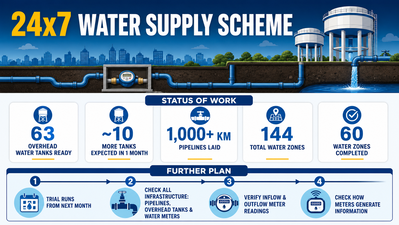
Pune: PMC is set to begin trial runs of its ambitious 24×7 equitable water supply project from next month. The project, announced nearly a decade back, is yet to become fully operational, though civic officials said around 88% of the civil works had been completed.The trial phase will initially cover nearly 60 water distribution zones where key infrastructure, including overhead water tanks and pipeline networks, has been substantially completed. As part of the exercise, Pune Municipal Corporation (PMC) will generate water bills based on meter readings to assess the billing and distribution system.PMC officials, however, clarified that residents would not be required to pay any water charges during the trial period. “The bills generated will be used solely for inspection and system testing purposes. Detailed modalities for the trial runs are still being worked out. There is no proposal to recover water charges from citizens at this stage. Bills and meter readings will be generated only to evaluate the system during the testing phase,” a civic official said.The 24×7 water supply project came under renewed focus after chief minister Devendra Fadnavis last month directed PMC to expedite pending works and complete the project at the earliest. The delay in execution has also become a political issue, with opposition parties, including Congress and NCP (SP), targeting BJP over the prolonged timeline.According to PMC’s water supply department, inadequate pipeline infrastructure and the absence of sufficient overhead storage facilities in several localities have affected equitable distribution of water across the city.Under the project, PMC has planned the construction of 83 overhead water storage tanks, installation of over 1,000km of new water distribution pipelines, and deployment of 2.75 lakh water meters. The project envisages the creation of 144 water distribution zones across Pune. “Work in nearly 60 water zones has reached the final stage, paving the way for trial runs. The project is expected to improve pressure management, reduce losses and ensure equitable distribution of water across the city,” an official from the water supply department said.Installation of water meters, considered a key component of the project, faced strong resistance from residents and housing societies in several parts of the city. The officials said multiple rounds of meetings were held with citizens and local corporators to address concerns and persuade households to allow meter installations.