
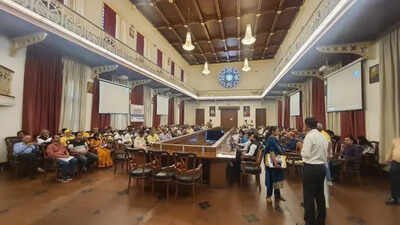
PUNE: Urban areas of the district are growing at an exponential rate, but civic bodies are falling alarmingly short at providing basics, including motorable roads, pollution control measures, garbage-free streets and, very importantly, adequate water supply.Lack of equity in water supply has in recent years topped the list of complaints against both Pune (PMC) and Pimpri Chinchwad (PCMC) municipal corporations. Burgeoning housing societies in these limits, as well in pockets governed by gram panchayats (Hinjewadi, Maan, Mulshi, Marunji, etc.) are struggling with water supply. Residents are largely dependent on tankers to provide them with utility water and, in many cases, potable water as well. But new constructions have not halted.In Aug 2025, a committee formed under the divisional commissioner decided at an HC-mandated ‘water meeting’ that PMC, PCMC and the Pune Metropolitan Region Development Authority (PMRDA) would all upload to their respective websites ‘water affidavits’ submitted to them by builders at the time of seeking building permission and occupation certificates. These affidavits state that the responsibility of providing water to residents in high-rises or new buildings is to be borne by the builder, until such a time that the civic body concerned is able to supply the water.The committee had been instituted after a diktat by Bombay high court over a public interest litigation (PIL) filed in 2023 by irate residents’ associations. This panel was instructed to conduct ‘water meetings’ of civic authorities and residents at a specified frequency. It would allow residents to verify if developers had submitted undertakings to provide water to their societies, and with what stipulations.The uploading of affidavits decided last year aimed to ensure that residents became aware of which developer was responsible for their water supply. In many cases, societies remain unaware and pay for tankers from their collected maintenance funds. This often compromises on other factors, like enhanced security, community gatherings or hiring additional housekeeping staff, among other things.The prevalent paradox is unnerving. In Pimpri Chinchwad, for instance, residents already receive water on alternate days, as PCMC has declared it does not have adequate water allocation from the irrigation department to meet daily demand. This forces residents not only of newly developed areas but also in older localities to depend on private tankers.But official data shows that PCMC still approved at least 4,168 new projects between Jan 2017 and July 2026, with developers required to submit affidavits undertaking ensured water supply to residents until the civic body provides the same.For Western Avenue housing society in Wakad, with 792 flats, annual expenditure on water is between Rs75 lakh and Rs1 crore, said society chairman Sudhakar Diwan. Residents took possession of their flats between 2019 and 2023.“From 2023 to 2025, our annual water expenditure was around Rs1 crore. Last year, we got some borewells dug in the society, bringing expenditure down to around Rs75 lakh a year. At current property prices in the area, we are effectively spending the cost of one new flat on water every year,” Diwan told TOI.He said the developer does not contribute towards water expenses, which are borne entirely through monthly maintenance collected from residents. “Our monthly maintenance is Rs4,000 per flat and a major portion goes towards water. We do have a solar system installed, which helps reduce our electricity expenses for common amenities. But if PCMC provides regular and adequate water, our maintenance charges would come down significantly,” he added.Residents of Palm Spring housing society, a 211-flat project that was completed in Wakad in 2024, face a similar situation. They said the project developer had at the time of possession collected a one-time maintenance deposit for 24 months. But residents alleged that this was exhausted within a year, after which they had to contribute the additional amount towards water expenses out of their own pockets. “We spent nearly Rs20 lakh on water tankers over the past year. In addition, the society incurred around Rs5 lakh for borewells. The shortage becomes particularly severe during the summer,” said society treasurer Vikas Shinde.Yet another such example is Star City housing society comprising 254 flats, developed in 2018-19 in Dudulgaon. The society gets some supply from the civic body, but it is insufficient to meet residents’ drinking water needs, forcing them to spend approximately Rs2-3 lakh a month on potable water.Society member Shivaji Gite said, “Under an agreement between the builder and the landowner, a pipeline was laid from a well owned by the landowner to the society. We now pay around Rs2 lakh a month for this water. Whenever there is a power cut or an issue at the landowner’s end, or when additional water is required for drinking purposes, we have to call tankers, adding another Rs30,000-40,000 to our monthly expenses. Unfortunately, this is the situation almost every month.“Arun Deshmukh, a member of the Pimpri Chinchwad Cooperative Housing Societies Federation, who regularly attends the court-mandated water meetings with civic authorities, pointed out, “HC had directed local authorities to discuss water-supply issues in these meetings and work towards resolving them. But for the past three years, meetings have continued without any concrete solution on ground. Societies are still paying for water, while no responsibility has been fixed for ensuring adequate supply.“Elsewhere, societies are not even able to access the undertakings that assure some semblance of water supply to them. In PMC limits, Majestique Rhythm County residents in Handewadi-Hadapsar cannot find the builder’s water affidavit on PMC or PMRDA websites. Their building permission was given by PMRDA, but the village was later merged into PMC in 2017. “In just the first phase of our society, we have 600 flats and depend on 42 tankers a day at the cost of Rs700 per tanker for all our needs,” said society chairperson Ashish Ingale.“We spend upwards of Rs1 crore annually just for water. Everything else including safety and security concerns are sidelined to fulfil this basic need. We have also filed a query under the Right To Information (RTI) Act to find out why we don’t get water, but have not heard back yet. We push tanker water through an RO purification system to use for drinking. The water is extremely hard and we are noticing increased skin issues and hairfall, but we have no alternative,” Ingale added.Residents said they have submitted multiple written applications to PMC to resolve their issue, but in vain — even as new constructions continue to mushroom around them.Expert SpeakThe arrangement between civic bodies and builders/developers creates what economists call a principal-agent problem. The builder and civic body make decisions, but residents bear the consequences. The builder’s main incentive is to supply just enough water to get the occupancy certificate. Once flats are sold, that incentive weakens. The civic body, meanwhile, feels less pressure to invest in a permanent network while a private arrangement is already running. Residents are left in the lurch, as they rarely know the true cost or quality of what they are getting. Once they’ve bought a home, they have little power to demand better. The legal picture makes this worse. The affidavit is signed to the civic body, not to residents, so buyers have no direct claim if the builder cuts corners. Enforcement depends entirely on the municipal corporation or gram panchayat choosing to monitor it. And, because these affidavits rarely carry a deadline, a ‘temporary’ arrangement can run indefinitely. A temporary water arrangement can be justified, but without a firm deadline for the civic body to take over, it quietly becomes a way of shifting a public responsibility onto households— Saylee Jog | Assistant professor, Gokhale Institute of Politics and Economics (specialising in urban governance and municipal finance)Official SpeakWe have started the process of uploading water affidavits on to our website and about 400 are done, but a lot more are still in the process. It will take some time. Once all are uploaded, we will look into segregating and streamlining them. Our priority now is to upload all of them first as directed. We cannot avoid giving building permissions as development has to happen in merged areas too. So, even if builders can give us reports from the ground survey department (indicating groundwater potential at the spot), we accept those. We are also prioritising uploading affidavits from areas like Mulshi, Hinjewadi, Maan and Marunji, as development is rampant here and their water source is far away— Shrikant Prabhune | Assistant director of town planning, PMRDAThe whole intention of uploading affidavits online is to help those buying houses in the merged areas, where water supply is an issue, so that they are aware of whose responsibility it is to provide water to them. We have also made the updated water affidavit a little more stringent as the current one is a little vague, allowing the builder/developer to wriggle out of their responsibility of providing water. We have sent the revised affidavit to higher authorities for approval. We decided to do this after we received complaints from a few societies. Since we have not received too many complaints, we are resolving those that we have with us already on a case-by-case basis— Pravin Shende | Superintending engineer, building permissions department, PMCThe process of uploading affidavits is under way. We haven’t received complaints of violations from any societies, so taking action against builders/developers flouting norms is not possible as of now. But societies should come forward if this is happening. We have also worked on making the affidavit more watertight and we are working on seeking approval for the new format— Ajay Suryawanshi | Joint city engineer, PCMC