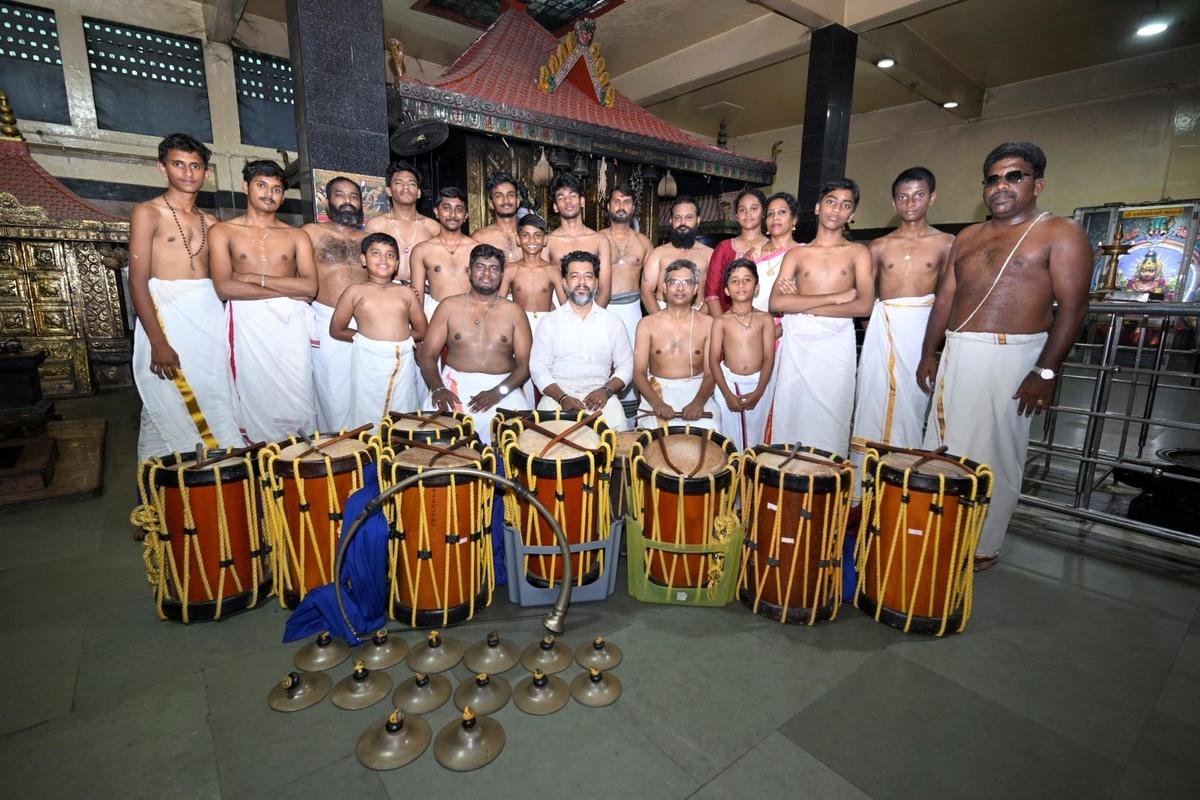


The artistes at the Gokulashtami special concert series in Bengaluru.
| Photo Credit: Special Arrangement
A Carnatic quartet comprising violinist Shreya Devnath, nagaswaram artiste Mylai Karthikeyan, and percussionists Praveen Sparsh on the mridangam and G. Silambarasan on the thavil, presented a carefully structured concert at Unnati’s Gokulashtami music series. The performance struck a fine balance between traditional repertoire and thoughtfully chosen compositions from beyond it.
The concert opened in the style of a temple nagaswaram recital with thavil setting the pace before Mylai Karthikeyan entered with Gambheera Nattai. The mridangam and violin joined in subsequently, leading into a Mallari composed by Karthikeyan, set in Sankeerna jati Triputa tala. The opening had the energy of a temple procession, while the four instruments lent it a concert setting.
The kriti ‘Ganamurte’ by Tyagaraja in Ganamurti followed with a short raga prelude. It was presented in a gait that could make effective use of sarvalaghu patterns in the kalpanaswara passages. Another Tyagaraja composition, ‘Hechcharikaga ra ra’ came after an outline of Yadukulakamboji. The presentation of this kriti, set to Khanda Chapu in a comfortable chowka kalam, allowed the rhythmic syllables to come through — without being hurried.
Behag brought a change in mood. A short raga alapana led to a brief tanam with the mridangam joining in. Swati Tirunal’s ‘Smara janaka subha charita’ was neatly rendered without any swara section.
The Bhairavi alapana was the expansive part of the concert. Shreya began the raga on the violin with Karthikeyan taking it forward on the nagaswaram. The two approaches to the raga complemented each other with the nagaswaram adding a different breadth to the phrases. Muthuswamy Dikshitar’s ‘Bala Gopala’ was the main kriti of the evening.
The swarakalpana, around the madhyama kala line beginning with ‘Drona karna’, was particularly interesting. Shreya shared that she had learnt the pattern from her guru Lalgudi Jayaraman when the maestro played a recording of his own rendition and explained the conception too. The pattern, built around the sequence ‘͘ri ͘sa ni dha pa ma ga ri’, was presented as an imagery of arrows released from a bow and reaching their intended targets, suiting the lyrics ‘Drona karna’, denoting the Mahabharata war. The quartet recreated this pattern with seamless coordination between the swaras and Adi tala in two kalai.
The tani avartanam was more vibrant compared to the relatively smooth accompaniment during the kritis, creating a distinct contrast. The violin and nagaswaram joined in for the concluding part of mohra — built in the same pattern rendered during the kalpanaswara part — making the concept enjoyable.
From here, the concert moved on to a broadened repertoire. Sant Tukaram’s abhang ‘Ba re Panduranga’ in Maand was followed by ‘Amar mallika bone’, a Rabindra Sangeet piece — adding variety to the line-up.
The familiar ‘Krishna nee begane baro’ by Vyasaraya in Yamunakalyani returned the focus to the Gokulashtami theme after the main kriti. Muthuswamy Dikshitar’s nottuswaram, ‘Rama janardhana’ was played in two kalams, its Western-tinged lines blended smoothly with the composition. The concert concluded with Lalgudi’ Jayaraman’s Madhuvanti tillana and the traditional mangalam.
The understanding among the musicians and the sensitivity with which each performed helped retain the characteristic vibrance of nagaswaram and thavil as well as the melodic familiarity of violin and mridangam. The concert brought together different musical explorations without making the contrasts feel forced.
Published – August 24, 2026 04:07 pm IST