


There was a time when a stainless-steel tiffin carrier packed with home-cooked food was an essential part of everyday life in Chennai. Today, that familiar sight is slowly disappearing, replaced by neighbourhood eateries, restaurants, cafés, food-delivery apps and subscription kitchens.
When writer Sivasankari, 82, looks back at Madras of the 1960s and 1970s, she vividly remembers the city’s desserts and ice creams. “Gaylord on Anna Salai, close to my office, and Jaffers, also on Anna Salai, were known for their ice creams, which were of international standard. Peach melba at Jaffers was my all-time favourite.”

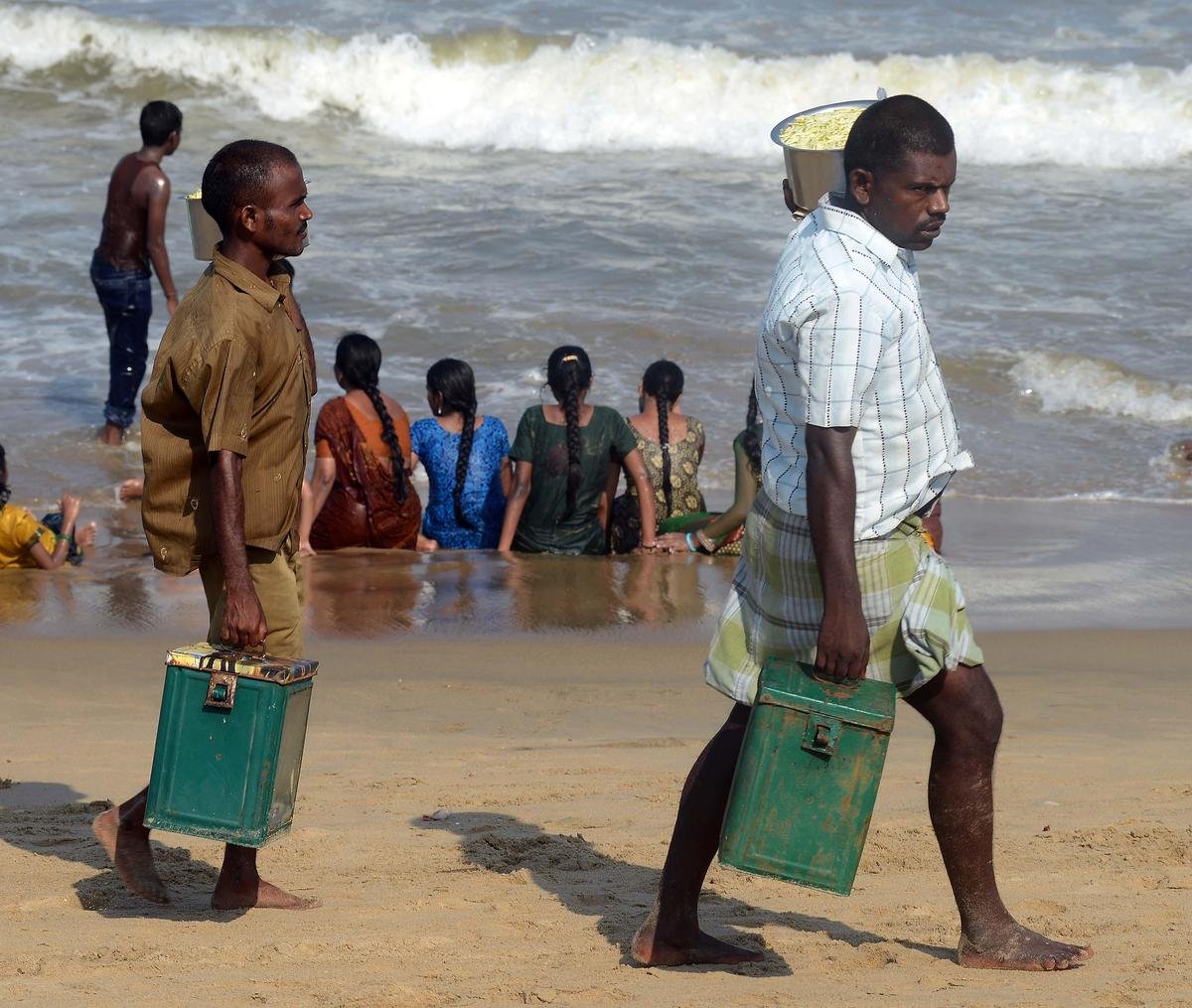
Sundal vendors on the sands of Marina.
| Photo Credit:
File photo

Corporate lunch in a Bento box, at Mekong restaurant, Marigold.
| Photo Credit:
SANGEETHA DEVI DUNDOO
Octogenarian Sabita Radhakrishna, cookbook author, textile researcher and founder of Udhavi, an NGO for elders, remembers a Madras where eating out was largely an occasional affair. She moved to Chennai from Bangalore in 1968.
“When I moved to Chennai, the city, then Madras, was conservative, and everyone loved home-cooked food. The culture of eating out was virtually non-existent. I would take my children out to eat every Saturday, mainly because I wanted a break from the kitchen. Our choices were limited in those days.”
“We used to frequent Buhari on Anna Salai, which had family rooms with curtains separating each enclosure. For Chinese food, there was Southern Chinese on Anna Salai. I also loved Woodlands Drive-In, which I dearly miss, and New Woodlands, which continues to maintain its quality even today. Shanthi Vihar at Luz Corner was another family favourite for chole bhature and chaat, which were quite rare in Chennai in those days,” she reminisces.
“We also used to order food from Hotel Coronet and Hotel Runs in Adyar, as well as from street-food stalls in Periamet. A visit to the beach was incomplete without pattani sundal and a few bajjis. Our family also loved picnics, carrying baskets packed with food, a flask of coffee and a few jamakkalams. We would usually head to spots around Mamallapuram or Chembarambakkam,” she reminisces.

Kabali’s Thai Ilai biriyani at Anna Nagar in Chennai.
| Photo Credit:
B. JOTHI RAMALINGAM
According to Sabita, Chennai’s foodscape was greatly influenced by entrepreneurs such as M. Mahadevan, who pioneered standalone restaurants in the 1990s and popularised the affordable buffet. Yet, she feels there are still gaps in the city’s culinary landscape. “I find that there are still no authentic restaurants serving Bengali food,” she says.
Food historian and MasterChef India judge Rakesh Raghunathan recalls another defining aspect of old Madras food culture. “We see abundance in everything these days. Conversations around food have increased with the rise of social media, and there is greater awareness about food in general. In Chennai, it was once customary to have the day’s biggest meal in the morning, followed by a light tiffin around 4pm, with leftovers often eaten for dinner. That is no longer the case,” he says.
“During my school days, we would eat out mostly for family celebrations, at places such as AVM Dasa or Mathura on Anna Salai. But with more people travelling and the city’s café culture evolving, eating out has become increasingly popular,” he adds.

An old photograph of the Buhari Hotel on Anna Salai.
A view of the Sundari Akka Kadai at Marina.
| Photo Credit:
B. Jothi Ramalingam
The shift became more pronounced around the turn of the millennium. According to Karan Karki, one of the prominent voices in contemporary Tamil literature, the city’s food scene began changing dramatically around 2000. “Malls with large food courts began to emerge, while small and large vegetarian eateries mushroomed across the city, particularly after the decline of the iconic Hotel Saravana Bhavan,” says Karki.
A native of North Chennai, Karki’s fiction is centred on Madras and brings to light the city’s lesser-known facets, including its food culture. He points to the way different neighbourhoods have developed distinct food identities. “In Chennai, we have the Dashamakan near Otteri, a vibrant culinary hub known for its affordable, high-quality beef street food, biryani, and kebabs. Similarly, the Marina Loop Road offers freshly prepared seafood, and these places are frequented not just by Chennaiites but also tourists.”
“South Chennai, which once had very few non-vegetarian restaurants, now has numerous biryani joints. Biryani is no longer a celebratory treat; it has become an everyday meal,” Karki observes.
Anna Nagar has become another food hub, drawing people from across Chennai for its range of food and desserts, particularly between 8pm and 3am. West Mambalam, meanwhile, continues to offer affordable, home-style vegetarian food. “You get kuzhambu, poriyal and kootu by the kilo, and most are ready by 7am. This makes it convenient for office-goers and families with children to pack food before leaving for work or school. Most of these are family-run eateries, which helps keep the prices under control,” says Karki.
According to Sridhar Venkatraman, a food enthusiast and civic activist, the food scene became increasingly commercialised with the launch of Orkut, a social networking platform by Google. Online groups encouraged people to review restaurants and explore eateries beyond their neighbourhoods.
“During the 1970s and 1980s, there were only a handful of vegetarian eateries in T. Nagar. I miss Gitanjali, Nathan’s Tea House, Bhat’s and Sudhara. Over the past 25 years, the restaurant scene in Mylapore has changed significantly, with several new brands emerging in the locality.” Yet places such as Jannal Kadai, Sundal Kadai, Bharathi Mess and Mami Tiffin Centre have continued to thrive, thanks in part to social media.

Revathi and her Japanese business partner who run Dahlia in Nungambakkam.
For Ram Bhat of Udipi Home, a 106-year-old brand, and Matsya, the transformation is closely linked to changing lifestyles. “People work longer hours, the joint-family system is no longer as common, and many elderly people are moving into assisted living. As a result, in an urban setting, cooking at home has reduced due to time constraints. Though we are in the restaurant business and live in a joint-family setup, we too end up getting food from our restaurant on a daily basis,” he says.
The city’s culinary choices have also expanded dramatically. “Italian and Chinese food were considered exotic in Chennai during my growing-up years. Today, the focus has shifted to Pan-Asian, Continental, Mexican, Japanese, Korean and Mediterranean cuisines. This sea change in food culture can be directly attributed to the emergence of social media,” Mr. Bhat says. He adds that Chennai’s customer profile has changed with people from across India moving to the city for IT jobs. “The city is booming, and restaurants have become meeting spots for friends and families.”
“Bun-butter-jam and tea are a rage. Tea shops are no longer a male bastion; women, too, throng them. Affordable food is available everywhere, from roadside puttu, soup, kaalan, sundal and vada-bajji to a wide range of other options. The city has something to offer everyone, whatever their budget,” says Karan.
“These days, there is a minimum waiting time of 30 minutes at almost any vegetarian restaurant. People no longer seem to invite friends and relatives home as often; instead, they prefer to meet in certain neighbourhoods and eat at a popular eatery there. Even when friends visit, tea or coffee is ordered through a food-delivery app,” he adds.
For a younger generation, however, convenience is not the only consideration. Health and personal preferences have become equally important.

Carrier Meals serving at New Andhra Melas at T. Nagar.
Jayashri of The Goodlife Eatery, which offers clean, sustainable food through a subscription service, says young working people are increasingly knowledgeable about food and health-conscious. “Our average customer is between 25 and 45 years old. We provide three balanced meals a day, both vegetarian and non-vegetarian, delivered to homes and offices. Currently, we send out more than 200 meals a day during lunch,” she says.
Myna Kitchen, launched last year by four young IT professionals on OMR, reflects another facet of this changing food culture. The company provides home-style food to offices across OMR, Velachery, Guindy, Padur and Porur. Sahil Ummer, an NIT-Trichy graduate and co-founder, says his own experience as a young professional led to the idea.
After many trials and errors, Myna Kitchen. was launched and they send out more than 700 meals a day.
Its an app-based subscription service delivers breakfast, lunch and dinner to offices, PGs, hostels or homes. “Our in-house menu engineer develops the weekly menu, which we keep as a surprise for our customers. The average age of our customers is between 23 and 32. Our next focus is on hostels within medical colleges and universities, where we see high demand,” he says.
For medical students such as Pragya B., food is increasingly shaped by demanding schedules and nutritional preferences.
“With classes, postings and exams, ordering food according to our preferences is much easier. Most of us do not like the food served in our medical college hostel, so we depend on food-delivery services in the neighbourhood. They customise meals to our requirements, with a focus on fibre and protein. Most importantly, they deliver at times that suit our schedules,” she says.
Perhaps the tiffin carrier is disappearing, but the Chennai meal is not. It has simply moved — from the dining table to the neighbourhood mess, from the roadside stall to the restaurant, and increasingly, from the kitchen to the doorstep. In a city that has embraced new cuisines, evolving habits and new ways of eating, one thing remains unchanged: Chennai continues to gather around food.