

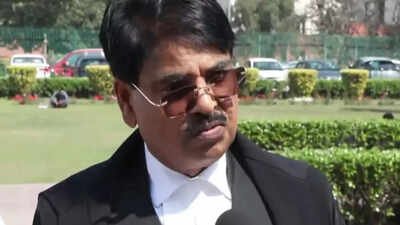
NEW DELHI: Senior advocate and Rajya Sabha MP Manan Kumar Mishra, who has headed the Bar Council of India (BCI) for more than a decade, is at the center of a controversy over the council’s now-withdrawn directive against the 2026 graduating batch of NALSAR University of Law.The BCI had initially directed state bar councils not to enrol NALSAR’s 2026 graduates as advocates, citing an alleged campaign by some students opposing the proposed invitation to Chief Justice of India Surya Kant as chief guest at the university’s convocation.The directive was withdrawn within hours following widespread criticism. The Supreme Court on Friday also questioned the BCI’s intervention, observing that students have a right to protest.
Who is Manan Kumar Mishra?
Mishra is a senior advocate and BJP-nominated Rajya Sabha MP from Bihar. He has served as chairman of the BCI since November 2014 and was re-elected to the post for a record seventh consecutive term in 2025.The BCI chairperson is elected for a two-year term.Mishra hails from Gopalganj district in Bihar. He completed his BSc (Honours) from Rajendra College, Chapra, and obtained his LLB from Patna Law College.He began his legal practice at the Gopalganj Civil Court before moving to the Patna High Court in 1982. He subsequently became a senior advocate in the Supreme Court.
From Congress candidate to BJP Rajya Sabha MP
Mishra has also had a political career. He contested the 2010 Bihar Assembly election on a Congress ticket before joining the BJP.In 2024, the BJP nominated him to the Rajya Sabha from Bihar, where he was elected unopposed.
What triggered the NALSAR controversy?
The controversy began after a section of NALSAR students wrote to the university’s vice-chancellor, registrar and faculty, opposing the proposed invitation to CJI Surya Kant for the upcoming convocation.The students’ objection came after remarks made by the CJI during a hearing concerning alleged police excesses against students during a July 20 protest march to Parliament.The BCI subsequently sought a factual report from NALSAR on those who had allegedly initiated, organised or mobilised the campaign.In his initial communication, Mishra said a law student who showed no regard for the country’s highest judicial office could raise questions about their suitability for the legal profession.The BCI then directed state bar councils to withhold enrolment of NALSAR’s 2026 graduates until further orders.
BCI reverses course
The directive triggered sharp criticism from sections of the legal community and social media users.Supreme Court Bar Association president Vikas Singh called the move “illegal”, “disproportionate” and “fundamentally unsustainable”, while also making clear that he did not endorse the students’ opposition to the CJI’s invitation.The BCI subsequently modified its order, saying the “vast majority” of NALSAR’s 2026 graduates were innocent and should not be made to suffer for the alleged conduct of a few.The revised communication allowed all 2026 graduates to enrol with state bar councils.Mishra later said the council had decided to close the proceedings altogether after considering representations from senior advocates, lawyers, students and members of the public. He said the 2026 batch had no role in any disturbance or movement and that no further action was required.
Supreme Court questions BCI intervention
The matter reached the Supreme Court on Friday, where a bench headed by CJI Surya Kant took a stern view of the BCI’s original directive.“Who can stop them,” the CJI said while observing that students have a right to protest.The bench, which also comprised Justices Joymalya Bagchi and V Mohana, questioned the BCI’s role in the matter, with the CJI observing that it was a dialogue between him and the students.The court issued notice to the BCI and directed that no punitive action be taken against NALSAR students or faculty at the instance of the BCI or any state bar council.The BCI’s counsel informed the court that the circular had already been withdrawn. The matter has been posted for hearing after two weeks.