

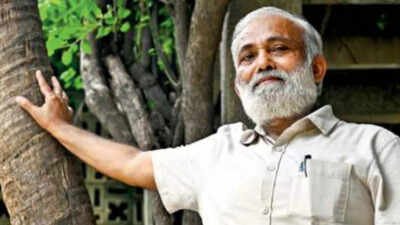
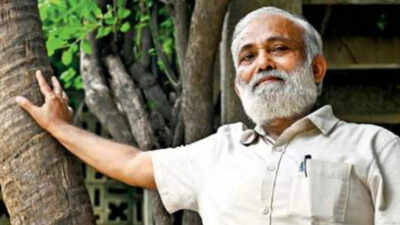
Children often notice things adults miss. As an eight-year-old, Arvind Gaur observed that students of a nearby public school arrived in shiny shoes carrying cool bags while kids from the municipal school in Shahdara would walk in dusty chappals.The stark class disparity would linger in his subconscious.“I think it still reflects in the kind of plays I work on,” says Gaur, founder of the socially-aware theatre group, ‘Asmita.’After shifting to a new school in Class 6, Gaur would face a more personalised form of discrimination. He had issues with speech fluency and pronunciation. The social science teacher wouldn’t let him read out loud in class.“I argued with the teacher, he threw me out of the class,” he recalls, displaying the defiant streak that has defined his life. In the end, he was allowed to read. But the incident also made Gaur realise the importance of ironing out one’s weaknesses.By Class 9, his efforts at self-improvement resulted in his excelling in school debates.A year later, Gaur scrapped the school authorities. The students were made to sit on the class floor. The jute mats bought for them were kept in a store and spread out only during inspections.A classmate, whose father worked in a steel factory, floated the idea of boycotting classes. For the first time, Gaur heard slogans like “Inquilab Zindabad.” Upon learning of the protest, the principal slapped some students, including Gaur.Many were coerced to attend classes. But, as if by magic, the elusive mats appeared in the classroom. “The incident taught me that change is possible with action,” says the 63-year-old theatre writer-director.Gaur discovered the world of theatre at an unlikely place, Delhi Public Library, Kuria Pul, during the summer holidays of 1968.“DPL used to be an active cultural centre those days. Thursdays were marked for drama,” he remembers. The first dialogue Gaur spoke on stage was from Badal Sircar’s iconic play “Julus” (Procession). The line was, “Kitna andhera hai (It’s so dark).”“Since then, we have been trying to fight darkness in our own way,” he smiles.The theatre director’s sparse productions have engaged fiercely with social and political challenges. Workers’ rights, religious intolerance, acid attack victims — his plays have spoken up for the marginalised and for outsiders.Not many know that Gaur was thrown out from a polytechnic institute in Delhi, where he was pursuing a course in electronics and communication, for being an active participant in student politics.“I felt the action was unfair. To fight injustice like these, I became a journalist,” he says.He worked for several newspapers, including Navbharat Times, where he wrote every Sunday on drama.In 1984, he would also work in relief camps, following the anti-Sikh riots. In 1986, he reworked a story published in NBT into a play, “Videshi Aaya” (The Foreigner Maid), a metaphorical protest on colonisation of language, and staged it with theatre workshop students of Zakir Hussain College.The first show was performed at the capital’s Boat Club and later staged in schools across Delhi over several years. Later, Gaur would also work in PTI TV. “This was the time when theatre people and journalists would converge, discuss and debate during evenings at Mandi House,” he says.In 1993, Gaur became a full-time theatre person enacting Asmita’s first play, Bhisham Sahni’s “Hanoosh”. On the morning of the opening show, the lead actor suddenly asked for money which the group didn’t have. “But we decided to go ahead with the show,” he says.The second lead stepped into the main role. Gaur would hold a script and read the dialogues for the second lead’s part. Among the audience was Sahni himself and writer Nirmal Verma.“The incident taught me a lesson. I will not rely on trained actors, but train my own actors,” he says. And he continues to do so. Among those who have attended his acting workshops are Deepak Dobriyal, Manu Rishi Chadha, Sonam Kapoor and Kangana Ranaut.Gaur recalls how Ranaut, then a teenager, stepped in after an actor playing a major role dropped out. Girish Karnad’s “Rakta Kalyan”, then attack—“She not only did her own small role, but also the big one. That too with hardly any preparation time. You can do this only when you are focused on the full play during rehearsals, not just your own part,” he says.The writer-director loves street theatre. “Earlier street theatre enjoyed political affiliation. Groups performed under a flag. We opted for independent street theatre for people,” he says.Over the decades, Asmita has performed in factories, colleges, universities, slums and colonies across the city and outside.Three giants hold a special place in his heart: Habib Tanvir, Ebrahim Alkazi and Peter Brooks. So do three plays. One, Swadesh Deepak’s Court Martial. Two, his own interpretation of Girish Karnad’s Tughlaq as a common man whose dreams are shattered in the end.Three, “Ambedkar aur Gandhi” which underlines the importance of dialogues even when views are different, something India needs more than ever before.Gaur is an eye-witness to the capital’s evolving theatre scene.He submits that there’s a substantial audience base for all forms of theatre today, that actors have more employment opportunities due to cinema, TV, OTT and, compared to the past, many more girls come for theatre workshops. But he also laments the absence of a policy on culture.“Govt spends crore organising theatre festivals but has no vision for culture,” he says.Unmindful, he remains devoted to theatre. The writer-director is looking forward to the solo play, “Aruna’s Story,” based on nurse Aruna Shanbaug’s case, to be performed in New York next month. Arvind Gaur keeps bringing one battle after another to the stage.