

In a modest training hall at SVR Industries in Pendurthi in Visakhapatnam, a group of 30 women sits in a semi-circle, eyes fixed on a table where ingredients are being measured with precision. Jowar powder is folded into moong dal flour, water is added at careful intervals and the dough is kneaded until it turns supple. Soon, it is pressed into thin strands of noodles and later steamed and sprinkled with curry leaves and peanut powder.

On another table, a fermented ragi java (porridge) is whisked into a milkshake and reworked into a cold coffee variant. A participant from Srikakulam follows the trainer and tosses cooked foxtail millet with cucumber, onion, mint, tomato, raw mango and pomegranate, finishing it with lemon and ginger juice, sunflower seeds and a generous sprinkle of peanuts podi. Leading the session is nutritionist Himanshu Kapoor, who guides each step with a mix of technical clarity and cultural memory.
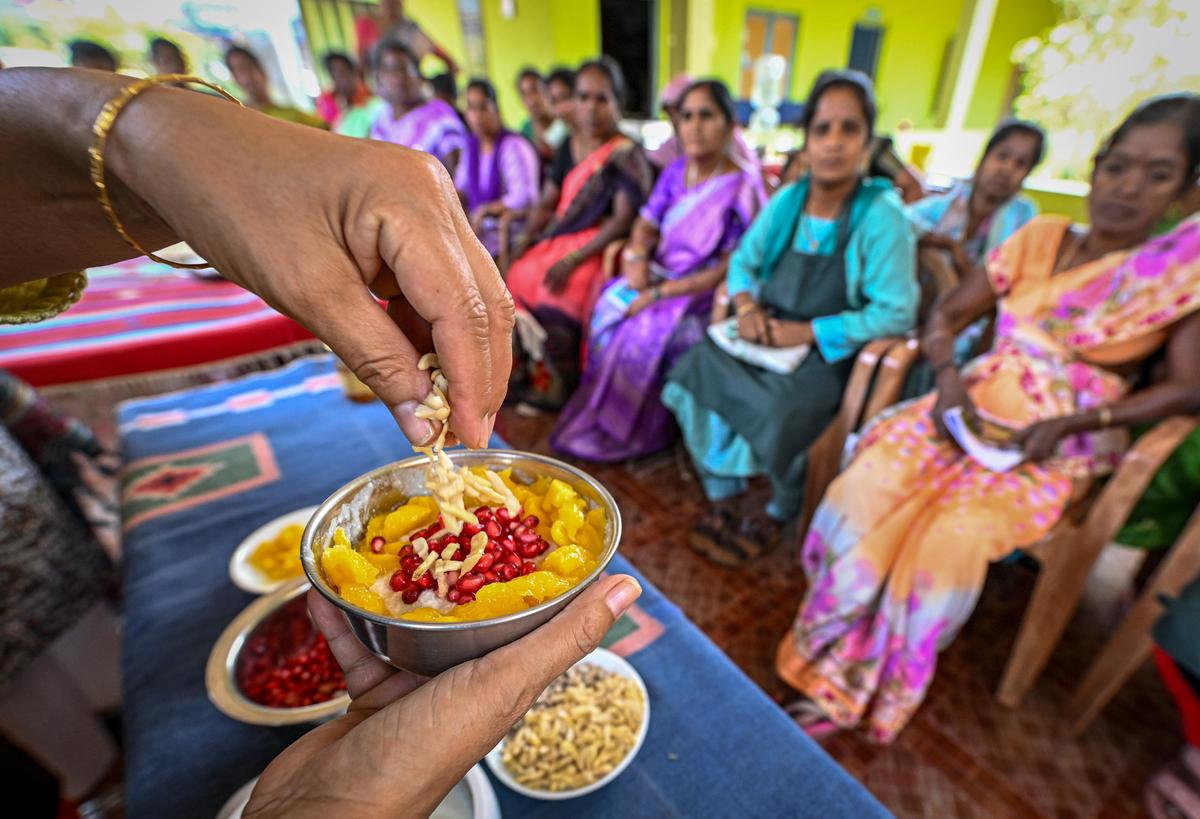
Himanshu Kapoor, a nutritionist, demonstrating the preparation of jowar and moong dal noodles at the three-day millet cart enterprise training workshop organised by Society for Elimination of Rural Poverty (SERP), Government of Andhra Pradesh, in association with Vishalakshi Innovations for Sustainable Ventures (VISV) in Pendurthi in Visakhapatnam.
| Photo Credit:
KR Deepak
This three-day zonal training programme, centred on millet cart enterprises, is more than just recipes. It is part of a larger effort anchored by the Society for Elimination of Rural Poverty (SERP), Government of Andhra Pradesh, under the NRLM (National Rural Livelihoods Mission) Lakhpati Didi programme.

Millets are steadily returning to the centre of food and farming conversations, valued for their nutritional strength, low water needs and relevance to rural incomes. In Andhra Pradesh, SERP is working to build women-led millet enterprises across the chain, from cultivation and processing to food products and retail. The initiative combines training, enterprise planning and market access to help self-help group women move towards running their own small businesses. The initiative is being carried out in association with Vishalakshi Innovations for Sustainable Value Chain (VISV) foundation, which is the enterprise and capability partner and supports this process by shaping business models and linking them to a wider food systems framework that stretches from farm to finished food.
Also Read : How Millet Sisters drive millet consumption in rural areas
The Pendurthi session is one among several such trainings being conducted across the State, with earlier rounds held in Chittoor, Ongole and Kadapa. The current batch brings together women from different districts, each carrying her own small enterprise or the aspiration to build one. Over three days, they have been introduced to a range of millet-based preparations that move beyond traditional staples. Noodles, cupcakes, pancakes and cookies find place alongside more familiar dishes. The idea is to widen menus and, in doing so, widen markets.
Himanshu Kapoor, who has been associated with the initiative from its early stages, frames the training in practical terms. “We are going deeper than merely teaching recipes. We are helping women understand how to translate nutrition into something people will buy every day,” she says. Her work, which spans school programmes, international forums and grassroots training, feeds into the structure of these sessions. “Millets have always been part of our food culture. What has changed is the way we consume food. So the approach has to change as well,” she adds.

For many participants, the shift is already visible. N Pavani, 32, from Narsipatnam, has been running a small stall serving millet idli, dosa and pongal. The training, she says, has altered her sense of what her business can be. “Till now, my menu was only breakfast. Now I have learnt to make cakes, noodles and cookies. These items can attract younger customers,” she says, holding a notebook and pen where she has been diligently jotting down the recipes.
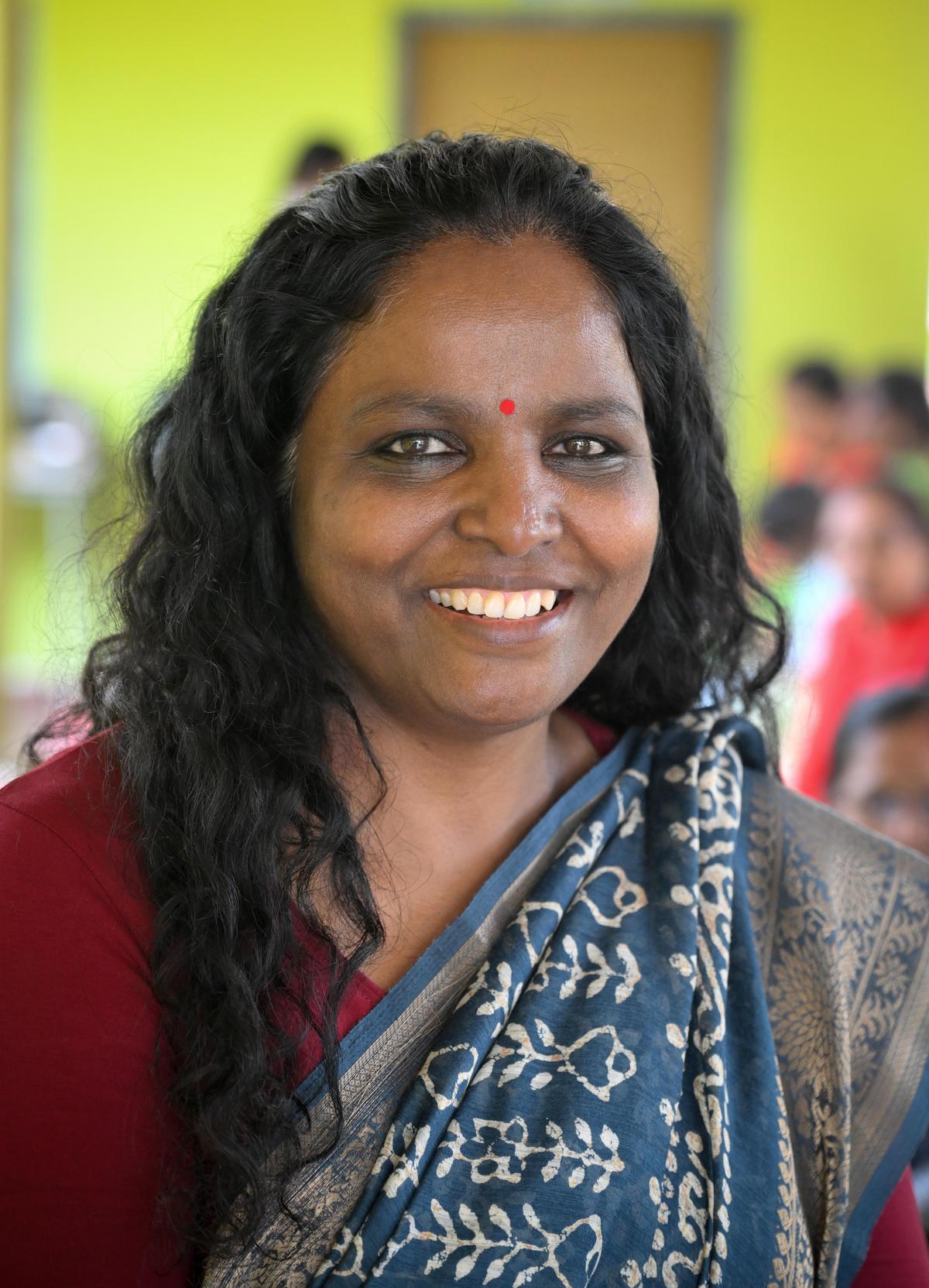
Vishala Reddy, founder of Millet Bank and Vishalakshi Innovations for Sustainable Ventures (VISV).
| Photo Credit:
KR Deepak
Since its pilot phase last year, the programme has trained around 400 women across 15 districts. “Our goal is to help rural women build livelihoods through micro-enterprises in the millet sector,” says Vishala Reddy, founder of Millet Bank and VISV. She places the effort within a longer historical arc. “India had a home-level food system that was self-sustained. There was seed saving, local processing and community markets. That structure has weakened over time. We are trying to restore it at a community level.”
The programme’s design reflects this broader ambition. It focuses is on activating women-led enterprises across the entire value chain, including production, processing, food products, retail and even circular applications such as waste reuse. The intention is not to isolate food preparation as a skill, but to embed it within a network of linked activities that can support sustained income.
Plug and play millet cart
At the Pendurthi training, this integrated approach is visible in the way sessions move from cooking to costing, from packaging to presentation. Participants are introduced to the idea of a plug and play millet cart, a mobile unit designed to standardise operations while allowing local adaptation. “Under the current phase, 30 women have been trained and 11 carts have already been distributed, with the carts designed by a Hyderabad-based vendor,” says Vishala, who has been spearheading the project and leading it along with SERP.
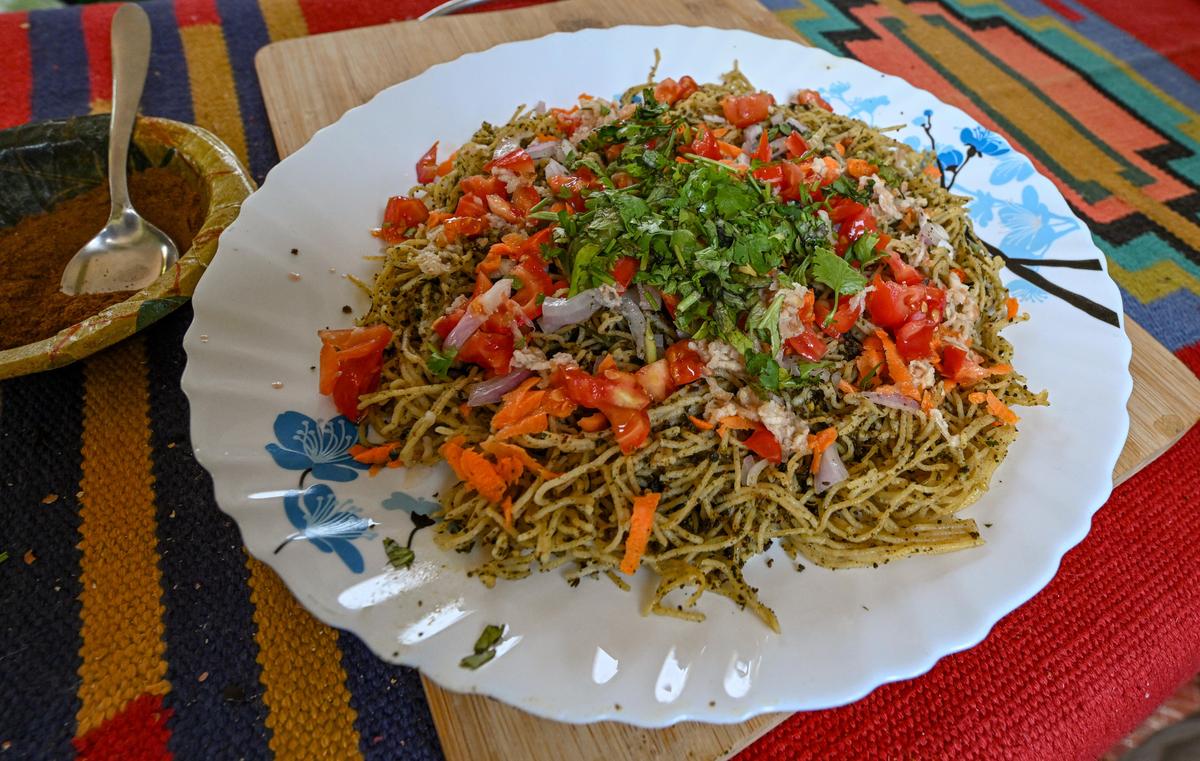
Preparation of jowar and moong dal noodles on display at the three-day millet cart enterprise training workshop organised by Society for Elimination of Rural Poverty (SERP), Government of Andhra Pradesh, in association with Vishalakshi Innovations for Sustainable Ventures (VISV) in Pendurthi in Visakhapatnam.
| Photo Credit:
KR Deepak
The three-day programme does not end with training. It moves into a phase of hand-holding, where participants are supported in setting up their own millet cart enterprises in their respective locations through micro communities in every district. This includes helping them network for sourcing of millets, pricing and customer engagement. “The aim is to reduce the gap between training and actual enterprise creation, a gap that often limits the impact of such initiatives,” says Vishala.

Himanshu Kapoor, a nutritionist, demonstrating the preparation of jowar and moong dal noodles at the three-day millet cart enterprise training workshop organised by Society for Elimination of Rural Poverty (SERP), Government of Andhra Pradesh, in association with Vishalakshi Innovations for Sustainable Ventures (VISV) in Pendurthi in Visakhapatnam.
| Photo Credit:
KR Deepak
Pendurthi is also being positioned as a hub for millet enterprise development. Plans are underway to establish an integrated training centre, along with a model millet café expected to open shortly. The café will be run by four women and will serve a range of millet-based dishes alongside other offerings and a plant nursery. For Vishala, such spaces are critical in shaping consumer behaviour. “We want to build what we call the power of pairing,” she says. “Millets can be combined with products people already enjoy. Coffee, mango, coconut, even local crafts. This creates more value and more opportunities for business.”

A foxtail millet-based meal preparation on display at a three-day Millet Cart enterprise training workshop organised by the Society for Elimination of Rural Poverty (SERP), Government of Andhra Pradesh, in association with Vishalakshi Innovations for Sustainable Ventures (VISV), in Pendurthi in Visakhapatnam.
| Photo Credit:
KR Deepak
This emphasis on pairing reflects a larger strategy to anchor millets within contemporary consumption patterns. By linking them with familiar tastes and experiences, the programme seeks to move millets from the margins back into daily diets. At the same time, it creates entry points for women entrepreneurs into different segments of the market.

A foxtail millet-based meal preparation on display at a three-day Millet Cart enterprise training workshop organised by the Society for Elimination of Rural Poverty (SERP), Government of Andhra Pradesh, in association with Vishalakshi Innovations for Sustainable Ventures (VISV), in Pendurthi in Visakhapatnam.
| Photo Credit:
KR Deepak
The scale of the ambition is considerable. The project envisions thousands of such enterprises across Andhra Pradesh, contributing to livelihoods, nutrition and climate resilience. “The goal is to support first-generation entrepreneurs within self-help groups, enabling them to transition into small and medium enterprises over time,” adds Vishala.
Back in the training hall, as the session draws to a close, the women gather around to taste what they have prepared. There is conversation, some laughter and quiet calculation. Recipes are being noted down, so are ideas. For many, this is the beginning of a shift, from cooking for the household to cooking for a market.
Andhra’s millet push that is turning women into entrepreneurs
In Andhra Pradesh millets are steadily returning to the centre of food and farming conversations.
| Video Credit:
The Hindu