


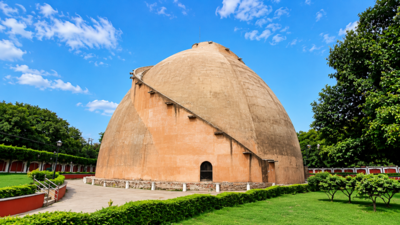
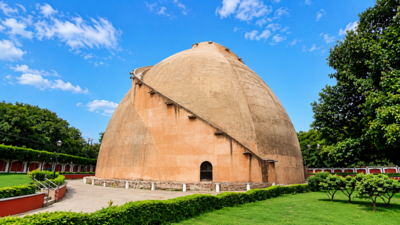
Patna: Patna’s iconic Golghar is one of the city’s most recognisable landmarks — an architectural marvel that has fascinated visitors for more than two centuries. However, behind its imposing beehive-shaped silhouette lies an extraordinary irony: the massive granary was never filled to its intended capacity because of a critical design flaw.Standing at the northwestern edge of Gandhi Maidan, Golghar was built in 1786 by Captain John Garstin, an architect and engineer of the East India Company, on the orders of the then governor general of India, Warren Hastings. The structure was conceived in the aftermath of the devastating Bengal famine of 1770, one of the deadliest famines of the colonial era, in which historians estimate nearly one crore people died.The crisis exposed the vulnerability of British-controlled territories to food shortages. When another, less severe famine struck Bihar in 1783, John Shore, then president of the Committee of Revenue, was asked to recommend measures to prevent a repeat of the catastrophe. Among his proposals was the construction of a massive grain store in Patna. The recommendation was approved in Jan 1784, paving the way for the construction of Golghar as a safeguard against future famines.Built entirely of brick and lime mortar without a single supporting pillar, the structure remains an engineering feat. Rising 29 metres high, with walls 3.6 metres thick at the base, it was designed to store up to 1,40,000 tonnes of grain. Workers were expected to climb one of its twin spiral staircases, pour grain through an opening at the top and descend using the other staircase.But the ambitious project was undone by a basic engineering oversight. All four doors of the granary were designed to open inwards. “If the granary had ever been filled to capacity, the enormous pressure of the grain would have made it impossible to open the doors,” said Indologist Prabuddh Biswas. The flaw meant the structure could never function as a fully operational famine reserve.After Independence, the Food Corporation of India used Golghar as a godown till 1998 before vacating it. Today, the protected monument has found a new purpose. Visitors climb its 145 spiral steps for sweeping views of Patna and the Ganga, while the monument stands as a reminder that even history’s grandest ideas can be undone by the smallest design mistake.