


The ghatam, one of the oldest percussion instruments in the Carnatic tradition, is a clay pot capable of producing a remarkable range of sounds through strokes delivered across its surface. Despite its musical richness, the traditional instrument has inherent limitations. Made from fired clay, traditional ghatams can weigh as much as 10–12 kg and are fragile. Each piece is crafted to a specific pitch that, while allowing minor adjustments, cannot be tuned across multiple srutis.
To address these limitations, ghatam vidwan N. Guruprasad has developed the ONE G (One Ghatam), a wooden instrument that reimagines the classical percussion instrument while retaining its distinctive tonal character. Weighing anywhere between three to four kilograms, the ONE G is lighter and more durable compared to its clay counterpart. It can also be fine-tuned to different srutis using a guitar processor with customised EQ patches, allowing artistes to quickly match any pitch without carrying multiple ghatams.
Raised in a family steeped in Carnatic music, Guruprasad trained under his father, K. Nagaraja Rao, before continuing his tutelage under ghatam maestro Vikku Vinayakram and later under V. Suresh and Madurai T. Srinivasan. Today, he performs internationally and mentors students across six continents. His career has taken him to prestigious venues such as the Kennedy Center in Washington, the Lincoln Center in New York and The Oval in England for the Incredible India festival, as well as the Johannesburg Philharmonic Orchestra.

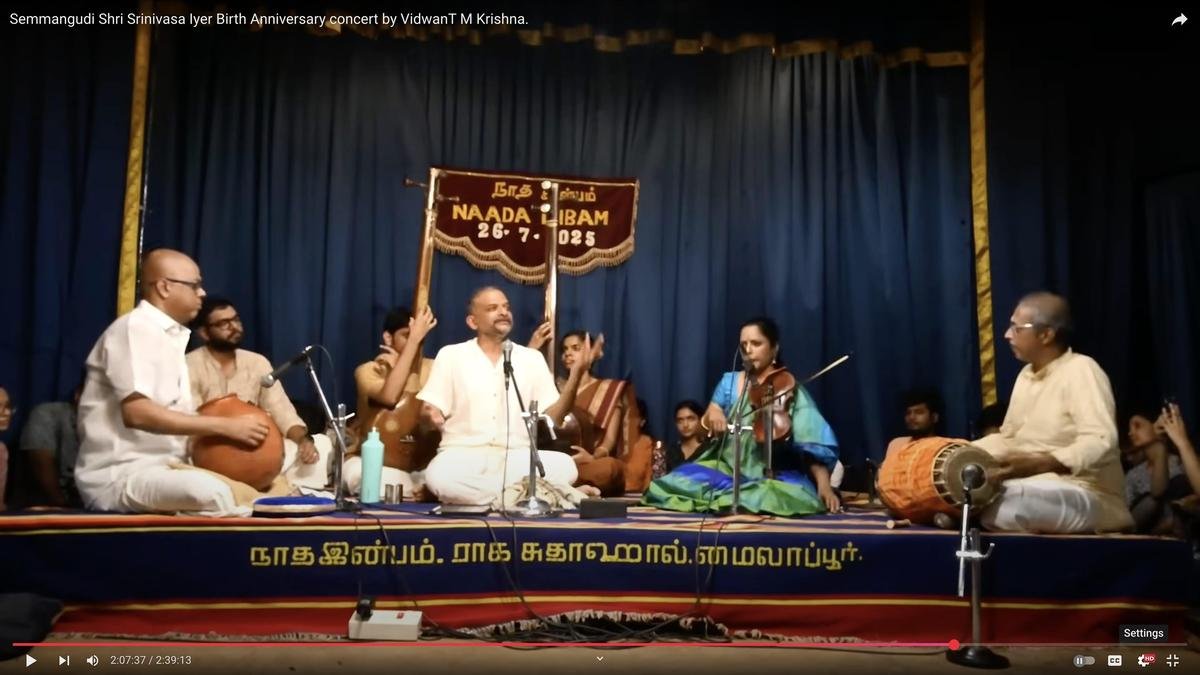
Guruprasad accompanying T.M. Krishna at the Semmangudi Srinivasa Iyer tribute concert at Ragasudha Hall in Chennai
| Photo Credit:
Special Arrangement
The idea for ONE G evolved after years of experimentation, says Guruprasad. In 2008, he first attempted to create a fibre ghatam, fitted with trigger pads that played back studio-recorded samples of his strokes. The aim was to retain the familiar playing technique while using technology to overcome some of the limitations. However, the system reproduced only his recorded naadam rather than the unique tonal character of the artiste playing it. After nearly two years, he abandoned the idea and began exploring an acoustic alternative.
Guruprasad’s next wanted come up with a ghatam that would produce the performer’s distinct sound, much like an electric violin, where the instrument’s vibrations are captured by pick-ups rather than reproduced through pre-recorded samples. He decided to make a ghatam with wood. “Unlike the mridangam, kanjira or even the veena, where wood primarily serves as a supporting structure, the wooden shell itself becomes the sounding body of ONE G,” he explains. Turning the idea into a viable instrument proved to be a challenge, taking nearly 16 years of research, experimentation and failures. One of the biggest challenges was finding craftsmen willing to carve a hollow instrument from a single block of wood. The density and grain also vary across the trunk, making the selection of wood itself critical.
Beginning with Chittoor-based artisan Arunachalam, Guruprasad later collaborated with craftsmen Kuppusamy Aachar and, subsequently, Sundaramurthy Aachar, whose expertise helped refine the instrument. Arriving at the ideal dimensions, neck profile and wall thickness was equally important. Unlike a clay ghatam, whose pitch is largely determined during the firing process, a wooden ghatam depends on precise wall thickness during carving. Even a slight variation can render it unsuitable for performance, he states.

Vikku Vinayakram, the ghatam maestro who first took the instrument to the global stage and is one of Guruprasad’s gurus,
| Photo Credit:
M. Moorthy
Drawing on the technical inputs of his colleagues — Neyveli Radhakrishnan and N. Ramakrishnan, violinist Sayee Rakshith, and sound engineers Chandramouli and Raja Subramaniam — Guruprasad took on the project’s most formidable task: recreating the unique acoustic character of the clay ghatam. Because clay is largely isotropic, vibrations propagate more evenly through it. Wood, by contrast, is anisotropic, with its grain affecting the speed and direction of sound transmission. The ONE G therefore uses a standard ghatam pick-up connected to a digital signal processor (DSP), where customised equalisation and pitch-shift settings recreate the tonal response of a clay ghatam.
“With the help of violinist Sayee Rakshith, we analysed the frequency spectrum of a traditional clay ghatam, including its fundamental frequency and resonant overtones, and developed custom EQ patches to recreate its tonal character as closely as possible,” shares Guruprasad. The system also enables features such as a clearly resonant lower-octave shadjam and the ability to produce dual pitches. Leading ghatam artistes, including Guruprasad’s gurus Vikku Vinayakram and V. Suresh, as well as peers Ghatam Karthick and G. Chandrasekara Sharma, evaluated the new instrument and observed that the ONE G is able to closely replicate the tonal qualities of a traditional clay ghatam.
The instrument also requires artistes to adapt their playing approach. In performance, a pick-up and an external microphone work together — the pick-up captures the higher frequencies, while the microphone reinforces the bass and acoustic character. It also minimises the need to play forcefully for projection. For touring musicians, another advantage is its relative resistance to changes in weather. It requires little maintenance, beyond occasional polishing and is less vulnerable to breakage compared. Guruprasad, however, stresses that the ONE G is not intended to replace the traditional instrument. “It should co-exist with the traditional clay ghatam,” he feels.
The ONE G has so far been tested in concerts and through trial recordings. Guruprasad believes its potential extends beyond Carnatic music, particularly to fusion and film music, where multiple octaves and advanced electronic processing can be fully explored.
Carnatic vocalist Vignesh Ishwar led the patent process, coordinating the paperwork and working with the patent attorney, with funding support from the Sumanasa Foundation, an arts-focused non-profit founded by Carnatic vocalist T.M. Krishna in 2005.
ONE G is set to officially launch on August 19 at Bharatiya Vidya Bhavan, Mylapore, Chennai, at 6 p.m.
Published – August 12, 2026 12:26 pm IST


