







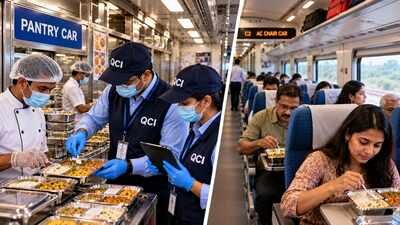
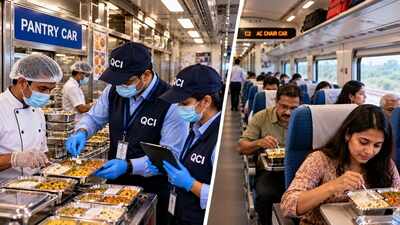
The food quality on trains may see an improvement with the Quality Council of India (QCI) looking to appoint certified professionals to carry out independent, technology-enabled checks of food safety and hygiene at railway stations and aboard trains across the Indian Railways network.Indian Railway Catering and Tourism Corporation Limited (IRCTC) has entered into a strategic Memorandum of Understanding (MoU) with QCI to strengthen compliance with food safety and hygiene standards across the railway system, according to a statement issued by the Railway Ministry“Under this strategic alliance, QCI will deploy certified professionals to conduct intense, unannounced quarterly and half-yearly inspection cycles,” the ministry said.It added: “These audits will enforce strict compliance with statutory Food Safety and Standards Authority of India (FSSAI) regulations and international culinary standards.”
Addressing passenger complaints on food
Officials said the decision to introduce independent inspections followed repeated passenger complaints about poor food quality and unhygienic catering practices. The ministry subsequently decided to bring in a third-party agency to audit food safety and hygiene.“To eliminate data tampering and guarantee absolute transparency, the audit process will leverage QCI’s pioneer digital infrastructure,” the ministry said.As part of the system, inspectors will use a mobile application to record their findings, with geo-tagging, time-stamps and photographic evidence made mandatory.Audit reports will have to be submitted within 24 hours, allowing operational shortcomings to be identified promptly and enabling corrective and preventive measures to be tracked against vendors found violating the prescribed standards.Explaining how the initiative would benefit passengers, the ministry said: “Rigorous independent screening across trains ensures passengers are protected from subpar onboard meal preparation.”It also highlighted the need for uniform hygiene standards at station-based catering facilities, stating: “Complete standardisation guarantees immaculate cooking environments across all major station-based static units,” the ministry added.The ministry said the use of digitally documented evidence and the requirement to submit reports within 24 hours would help speed up corrective action and the imposition of penalties against catering licensees where necessary.
IRCTC Food checks
Indian Railways serves an average of around 58 crore meals annually. Over the past three years, IRCTC has taken punitive action in response to complaints against several vendors.According to a recent PIB release, these measures include imposing fines of Rs 5.13 crore, issuing 54 show-cause notices, terminating six contracts and debarring licensees for violations related to food quality and hygiene. IRCTC has made the list of debarred licensees available on its website.Railway and IRCTC officials, including Food Safety Officers, carry out routine as well as surprise inspections to check food quality, hygiene, safety and compliance with applicable regulations.These inspections examine several aspects of catering operations, including food safety, staff deployment, upkeep of equipment, cleanliness and adherence to prescribed standards. They also seek to encourage best practices in food handling, storage and preparation.According to Railway minister Ashwini Vaishnaw’s recent reply to a question in Rajya Sabha, IRCTC is taking the following measures on food quality:
- Providing meals that are prepared at designated base kitchens.
- Setting up modern base kitchens at some select locations.
- Installing CCTV cameras in base kitchens that enables real-time surveillance and improves the monitoring of food preparation.
- Identifying and using popular branded raw materials for preparing food.
- Appointing Food Safety Supervisors at base kitchens to oversee food safety and hygienic practices.
- Deploying IRCTC supervisors on board trains.
- Carrying out deep cleaning at regular intervals and conducting periodic pest-control activities in base kitchens and pantry cars.