
In the 1960s, Chennai was a quiet city with tree-lined boulevards, bungalow-studded neighbourhoods, and the beginning of an art movement that would become synonymous with Madras. The city was steeped in tradition but one willing to allow through the cracks the influence of English protest music. Much of that came from the West — mostly the UK and the US — from musicians who sang about everything from Civil Rights and the war in Vietnam to just wanting ‘to hold your hand’.
Rock music, with its barbed guitar riffs and growling voices, came to wooded college campuses with a gentle lilt — students sang of American themes in Indian hostel rooms on quiet evenings.

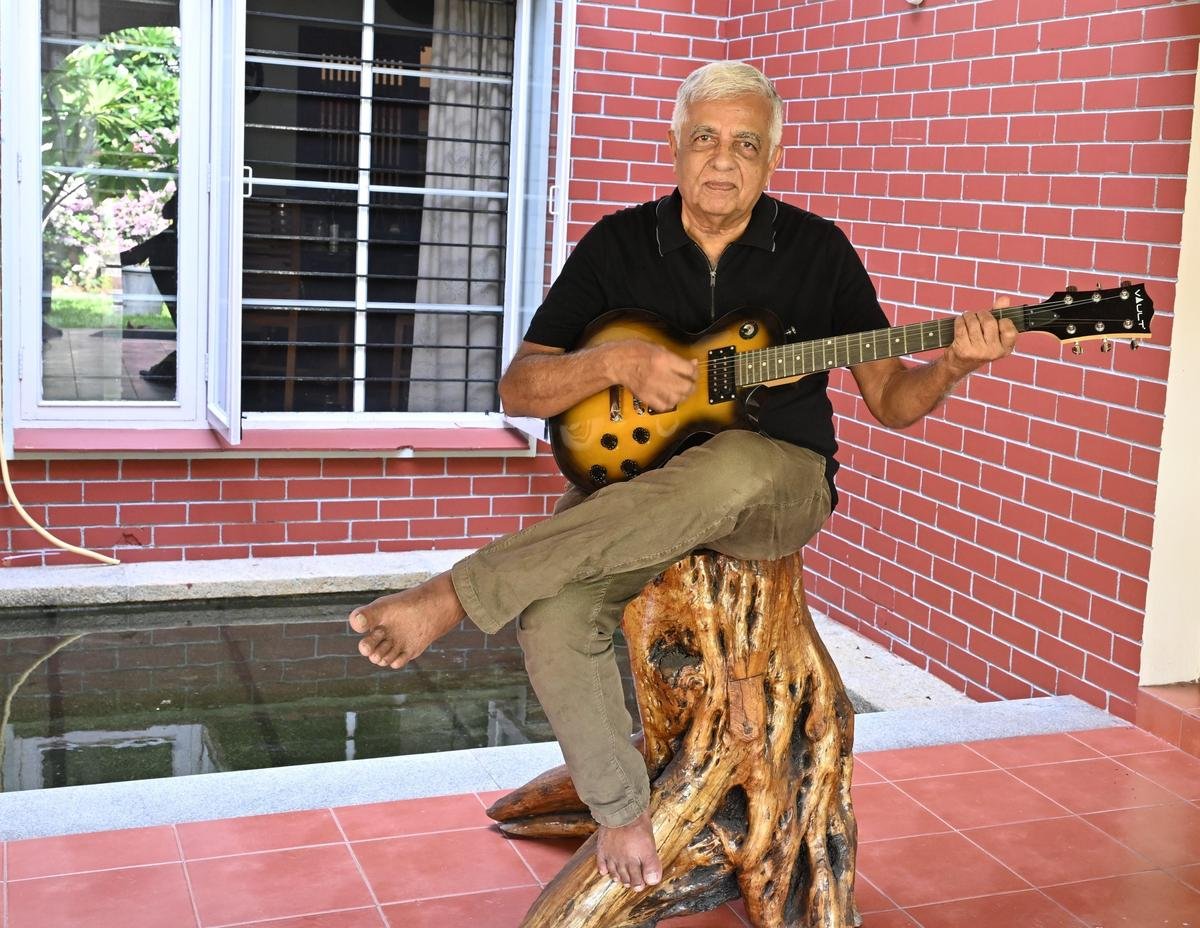
Captain Mohan Ranganathan
| Photo Credit:
R RAVINDRAN
Mohan Ranganathan, 78, a retired airline pilot whose work took him across Asia, and who flew The Hindu’s DC-3s from 1973 to 1978 (the newspaper had its own aircraft to transport copies to distant regional centres), grew up in the verdant campus of the Madras Christian College. “I was a student but was also raised there because my father was a professor of Chemistry. I learnt to play the guitar as the campus and the halls (hostels) were filled with music. It was like a big family,” says Mohan who captained the basketball team, and played the guitar with a band called the Selaiyur Swingsters, named after Selaiyur Hall.

The Selaiyur Swingsters. Capt Mohan Ranganathan is to the extreme right
| Photo Credit:
Special arrangement
It was on one of those evenings that Mohan became friends with George Cherian and Derek Norris. “Derek often spent summer with my family in Kodaikanal. He would play the saxophone and I would back him up on the guitar. We played covers, mostly The Beatles,“ he says, adding that the warden once confiscated the instruments for practising during college hours and much to his embarassment reported the matter to his father.

Ambi the Kambi and the Wires was also a popular music band from Madras Christian College
| Photo Credit:
Special arrangement
But Mohan’s abiding memory of that time is bookended by two photographs that capture The Mustangs, one of Madras’s iconic bands from that era. The first is of the band rehearsing at his home in MCC, the second is from 50 years later, again at his house in Chennai when they reunited to perform in the city.

The Mustangs were from MCC, but before they grouped they played for different halls. “George (vocals, violin and lead guitar), Derek (saxophone and main vocals) and Anand Padmanabhan (drums) were from Bishop Heber Hall and part of a band called Silhouettes. Tim Tharasingh (rhythm guitar) and I were from St Thomas Hall and we formed The Thunderbirds. George and I were classmates and we thought we should listen to each other’s bands play. When we did, we decided to get together and form The Mustangs in 1965,” says bass guitarist Haroon Mohamed, 82, on a call from Melbourne.

Haroon Mohamed of The Mustangs
| Photo Credit:
Special arrangement
Haroon hailed from a family with musical roots. His father, an architect from Sri Lanka where evenings resounded with the sound of guitars and pianos, was also a painter of scenes from the Hindu epics. His mother, who was schooled at Vidyodaya, took him to operas like Mikado, played Gershwin on the gramophone, and kept an open house where the likes of famed pianist-conductor Handel Manuel came carolling at Christmas. A paternal uncle was first violinist for the BBC Symphony Orchestra.
“In my pre-university year at Loyola College I was part of a folk music band, Teardrops with Dr Bharani (actress P Bhanumathi’s son.) The Mustangs were influenced more by American surf music drawing inspiration from bands such as The Ventures (whose ‘Escape’ The Mustangs cut a 45 record on) and The Shadows.”
The Mustangs were primarily an instrumental band and their first concert was at the YMCA in George Town. Later they cut two records with HMV which placed them in a different league. “The studio was in a lovely bungalow in Gemini Circle and Mr Sen who lived upstairs recorded us. I composed ‘Nina’s Theme’ for my girlfriend.”

Frustrations Amalgamated, fronted by Shyam Sunder, won the all-India Simla Beat Contest, in 1972
| Photo Credit:
Special arrangement
Just like the nationwide Simla Beat Contest organised by Simla Cigarettes, (the band Frustrations Amalgamated from the city with frontman Shyam Sunder won in 1972) Madras had its own battle of the bands, the Musical Knock-Out, organised by a small newspaper called The Student Times. The Mustangs won in 1966 and ‘67. “There were bands like the Medics from Madras Medical College (Dr Ravi Santosham, chest physician was among them) and BeatX from IIT. We played numbers like ‘Walk Don’t Run’. Girls showered Cadbury’s chocolates on us and plenty of the audience turned up in the striped shirts similar to ours,” says Haroon.
There were also the not-so-pleasant memories. In the midst of the anti-Hindi agitation in 1965, Haroon went to pick up his guitar at the Centenary Auditorium where they had been rehearsing and found it to be blood-splattered.
“We often went in taxis to hire an amplifier or drum kit and rarely made money. And rock music then was seen as something that happened only at nightclubs,” says Haroon, recalling how the band scattered across the globe once they graduated. They however regrouped in 2011, 2015 and 2017 in India for concerts to packed audiences.

Radha Thomas performs with Of Human Bondage
| Photo Credit:
Special arrangement
Radha Thomas, nee Ramachandra, Bengaluru-based jazz singer, writer and administrator of the Fraser Canine Squad, who joined a band fresh out of school, also has an unforgettable experience to share. “Our band, Of Human Bondage, had a three-night engagement at The Music Academy in 1975 and it quickly got sold out. There must have been a huge crowd trying to get in, because suddenly in the middle of a tune, a guy fell through the rafters and landed on stage. I don’t think anyone was hurt,” she laughs. “We travelled all the time and performed every night in a club or disco, usually for three-or-six month residencies singing Allman Brothers, Janis Joplin…”
Pramila Rajan, 67, former director, Madras Crocodile Bank, says her exposure to rock music came from Radio Ceylon. “We used to scribble down the lyrics in notebooks. It wasn’t until later that I was ‘allowed’ to concerts and that’s how I got to hear Uriah Heep and Kochi-band 13AD perform.”

Dominic Johnson, ex-staffer with Stereovision
| Photo Credit:
Special arrangement
Similarly it was the radio that ignited a love for music in Dominic Johnson, 65. The former Stereovision staffer who is a veritable encyclopaedia on all things rock also gently underlines the contribution of the Anglo-Indian musician. He plays no instrument but his friend and he wrote down the lyrics and taped every episode of UK Top 40 and compared notes every Sunday.
“BeeGees and Creedence Clearwater Revival were favourites. Anything that wasn’t death metal was,” says Dominic, who was often called to judge at Mardi Gras, (now Saarang), IIT-Madras’s cultural festival. Among the home-grown bands Dominic swears on the amazing music that came from Mumbai-based Atomic Forest and the Chennai-based Caravelles, Maiden Voyage and Avengers with musicians like Dheena Chandradhas, Tommy Smith, Bruce Roberts and Preston Gomes. “These chaps would get on stage with just their raw talent. They often played at cabaret hotels such as Shiraz Hotel Imperial, Pals on Mount Road and Golden Bowl at Savera. And, of course, Hotel Arun, now the Ampa Skyone,” he says.

The Shades, an Anglo-Indian band from Madras
| Photo Credit:
Special arrangement
Dominic adds that the bands of the 1970s registered their stage presence with their headbands, afro hair and bell bottoms. “The bell bottoms had to be 36 inches minimum. Ian Harvey, known as the ‘Eric Clapton of the South’, wore a round black cap, his hair long and flowing. The Anglo-Indian was born with a legacy of music and the body language of music. Sadly they didn’t know how to monetise it; drink, dine and dance didn’t get them far.”

The Second Coming. Reji Varghese is at extreme right
| Photo Credit:
Special arrangement
Sengen Joachim, late saxophonist of The Avengers that played at the Hotel Connemara coffee shop, later formed The Second Coming, a band in which city-based entrepreneur Reji Varghese is a guitarist. Reji’s love for rock came from his maternal uncle who took him to Safire theatre to watch musical documentaries made in aid of Bangladesh, protest music for Vietnam, and Woodstock. “‘My Sweet Lord’ has remained a favourite,” says Reji, 62. The year he finished high school he got a Japanese Aria guitar and it served as a catalyst for his passion. “Madras then was a city where music was born of protest, not commercial intent,” he says.
Or, perhaps of love. I ask Haroon if he is still in touch with Nina. He pauses, then says, “I married her.”