











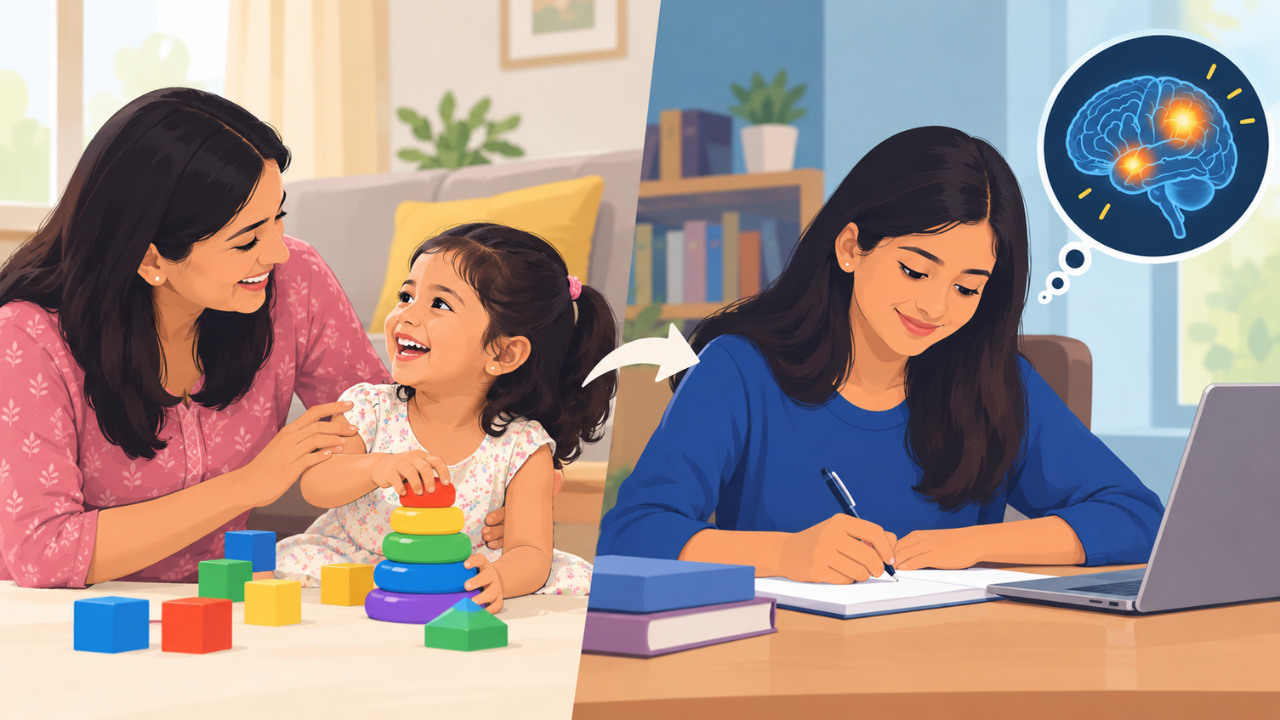
A parent encourages a toddler who is struggling with a puzzle. Another responds warmly when a child tries something new. These moments may seem ordinary, but researchers have found that the quality of parent-child interactions in early childhood is linked to how children’s brains respond to rewards years later. In a study that followed 465 children from early childhood through adolescence, researchers observed how parents interacted with their 3-year-olds and later measured the children’s brain responses to winning and losing. Those who experienced more warmth, support and encouragement early in life showed stronger brain responses to rewards as they grew older.The findings suggest that early parenting may be connected to how children process positive experiences during a period when they are also developing emotionally and socially. The study does not prove that positive parenting causes happiness, but it offers a closer look at one possible link between early family experiences and later mental health.
28 Sept 2026 | 08:18
Does your teenager tell you about their friends, or do you often have to ask? How much do you know about their social life?
Researchers followed the children from age 3 to 18
AI representation/ChatGPT
The research was led by Kaylin Hill, a psychologist at the University of Notre Dame, and her team. The study, published in Communications Psychology, examined the relationship between parenting behaviour at age 3 and the development of the brain’s reward response at ages 9, 12, 15 and 18. At the beginning, researchers observed parents interacting with their young children in a laboratory setting. They recorded positive behaviours, such as warmth, support and encouragement, as well as negative behaviours, including harshness and excessive intrusiveness.Years later, the researchers measured the children’s brain activity using electroencephalography (EEG). During a guessing game involving money, the participants received feedback on whether they had won or lost. The team then examined how their brains responded to these outcomes. The study found that children who experienced more positive and less negative parenting at age 3 tended to show stronger reward-related brain responses across adolescence.
What does a stronger reward response mean?
The brain’s reward system helps people respond to positive outcomes, including success and other rewarding experiences. The way the brain processes rewards is relevant to researchers studying pleasure, motivation and mental health. In this study, the researchers measured a particular electrical signal associated with reward processing. Children who had experienced warmer, more supportive parenting showed a stronger response when they won money in the guessing game.This does not mean the researchers directly measured how happy the children were in everyday life. Nor does it mean that children who receive less encouragement cannot enjoy positive experiences. The findings point to an association between early parenting and a measurable aspect of how the brain responds to rewards.
Why warmth and encouragement may matter in early childhood
Young children depend on adults to help them understand unfamiliar situations, manage frustration and respond to new experiences. A parent’s reaction can influence whether a child feels supported while trying something difficult or feels criticised for getting it wrong. Warmth does not mean agreeing with everything a child does or avoiding boundaries. It can mean listening when a child is upset, acknowledging their feelings, offering encouragement and correcting behaviour without humiliating them.For example, when a toddler struggles to complete a puzzle, a parent can offer a hint rather than immediately taking over. When a child makes a mistake, an adult can explain what went wrong without making the child feel that the mistake defines them. These interactions allow parents to guide children while maintaining a supportive relationship.
Could early parenting influence later mental health?

Photo: Canva
The researchers believe reward processing may be one piece of the puzzle when it comes to understanding why some people are more vulnerable to mental health difficulties, including depression. A reduced response to rewards has been studied in relation to depression and difficulties experiencing pleasure. By examining brain responses over several stages of development, the research team sought to understand whether early family experiences were associated with how these responses changed over time.However, the study was observational. It cannot establish that parenting alone determined the children’s brain development or future mental health. Family history, stressful experiences and other environmental factors may also play a role. The findings also do not mean that parents who struggle, lose patience or make mistakes have permanently harmed their children. The researchers’ work points to a possible connection between early interactions and later development, not an unchangeable outcome for any individual child.
What parents can take away from the findings
The research offers a reason to pay attention to everyday interactions, rather than treating parenting as a series of major decisions. Children experience family relationships through repeated moments: how adults respond when they are frustrated, whether their attempts are encouraged and how mistakes are handled.Parents can try to:
- Respond warmly to children’s feelings: Acknowledge frustration or disappointment before rushing to correct the situation.
- Encourage attempts, not just successful results: Notice when children keep trying, ask for help or work through a problem.
- Set boundaries without unnecessary harshness. Correct behaviour clearly while avoiding insults, ridicule or excessive control.
- Make room for positive shared experiences. Play, read, talk and spend time together without making every interaction about performance or achievement.
No single parenting style can guarantee a child’s future happiness or protect them from every mental health difficulty. But the study adds to research suggesting that the emotional climate of early parent-child relationships may be relevant long after the toddler years have passed.