

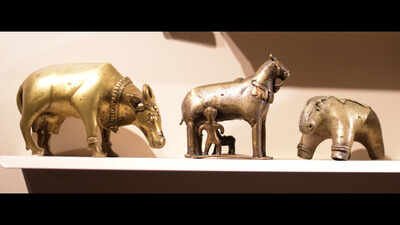
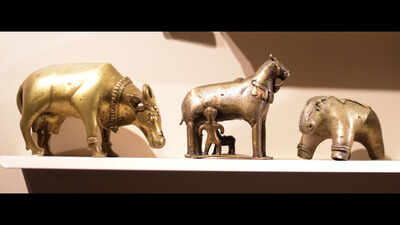
A lota, a colourful trunk, an old metal lock and a rolling pin — objects that were once a part of everyday life have now found a new home in the relocated Sanskriti Museum of Indian Textiles & Everyday Art at the Humayun’s Tomb World Heritage Site Museum. It reopened on August 1 for visitors, inviting them to look at a selection of two thousand artifacts and at least 500 beautifully patterned textiles of Patola, Bandhini and Pashmina among others.Collected over four decades by Sanskriti founder OP Jain, these artefacts were earlier housed at Sanskriti Kendra in Anandgram. The collection was gifted to the Indira Gandhi National Centre for the Arts (IGNCA) in 2023.The primary challenge was to move the collection to a new place without compromising on the identity of the original museum. “We thought we would replicate the original Sanskriti Museum. That was the idea, to preserve its identity even as it shifted its base to a more tourist-friendly place,” says Aakash Singh, Project Assistant, Conservation Division, IGNCA.Tracing the journey of lifeThe curation invites the visitor to follow the journey of a person’s life, right from their childhood to adulthood.“The curatorial flow covers everyday objects and an entire lifecycle of a person. Right from their childhood to when they grow up and learn to read and write, and then the next stages of life through work implements and kitchen categories,” says Archana Saad Akhtar, Programme Director, Design, Aga Khan Trust for Culture.Beauty beyond utilityMeanwhile, for textile conservator, Shakshi Gupta, the collection’s timelessness is captured in the founder’s ability to look past these regular objects and see the beauty in them. “OP Jain sir could see the object beyond its utilitarian purpose. He saw art in ordinary, everyday items like trays and spoons, and nutcrackers,” she says.The attention to detail is what makes these ordinary items extraordinary. “For instance, the rolling pin has a ghunghroo attached to it, and the rolling board has an intricate design at the back of its board which you only get to see when its resting upright on the shelf, lending these so-called mundane things a specific kind of beauty,” adds Akhtar.“I hope after seeing the gallery, the visitors cultivate an interest and appreciation in everyday objects,” says Gupta.The Sanskriti Museum is open to visitors on all days except Mondays, from 10 am to 6 pm. The entry ticket fee is Rs 50.— Anvita Singh