









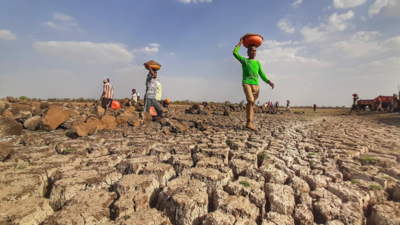

PUNE: At least 218 districts across India — over 25% of all districts — are showing drought-like conditions based on rainfall received over the last four weeks, with India Meteorological Department’s (IMD) Standardized Precipitation Index (SPI) placing them in the moderate, severe or extreme dry categories.The latest four-week period of Aug 13-Sept 9, 2026, has 30 more such districts than the corresponding period of Aug 17-Sept 13, 2023, which recorded 188 districts in these categories. The year 2023 witnessed a below-normal monsoon, too, and was the last strong El Niño year before 2026.Although the overall number of dry-category (including mild, moderate, severe or extreme dry) districts has declined marginally from 469 in 2023 to 454 this year in the said four-week period, the severity of dryness recorded has increased. The shift comes alongside a sharp fall in mildly dry districts, from 281 to 236, suggesting that more districts with below-normal rainfall are experiencing relatively more pronounced rainfall stress, and have hence moved categories.As per an IMD map, a marked presence of drier districts can be seen in the Marathwada and Vidarbha regions of Maharashtra, as well as several districts of Gujarat, Andhra Pradesh, Rajasthan and Meghalaya, and some parts of Punjab-Haryana.At the same time, the number of districts in moderate, severe and extreme wet categories has jumped from 58 in 2023 to 86 this year, pointing to sharper rainfall extremes at both ends.Dr Satyaban Bishoyi Ratna, head, climate application and user interface, IMD Pune, told TOI, “Districts falling in the moderately dry, severely dry and extremely dry categories can be considered to be experiencing drought-like conditions in terms of recent rainfall, with such conditions potentially affecting agriculture and water resources. SPI primarily assesses meteorological drought, which is based on rainfall conditions.”He clarified that the SPI-based assessment relates to the recent four-week rainfall situation, and does not incorporate factors such as temperature or soil moisture.Ratna said, “Dry conditions are being witnessed in many parts of the country over the recent four weeks. If such conditions persist, they could raise further concerns for agriculture and water resources, as inadequate rainfall can affect crop growth and productivity. The impact is more direct in rural areas, where rainfall is closely linked to agriculture and other aspects of daily life, while urban areas may have access to water sourced from tankers.”The SPI distribution shows that the increase is not because more districts are dry overall, but because a greater share of the dry districts has moved into more severe categories.The number of moderately dry districts has risen from 97 in 2023 to 120 this year, while severely dry districts increased from 50 to 65. Extremely dry districts, however, declined from 41 to 33. The key change, therefore, is in the severity of recent rainfall deficiency: there are fewer districts in the mildly dry category, but more in the moderate and severe categories.SPI is a rainfall-based indicator that compares precipitation received over a given period with the historical rainfall expected for that period. Increasingly negative SPI values indicate increasingly dry conditions. The four-week SPI is therefore useful for identifying recent rainfall stress, though it is not by itself a direct measure of groundwater levels, reservoir storage or overall water availability.The data has also shown an increase in districts experiencing more pronounced wet conditions. Moderately wet districts have increased from 33 to 44, severely wet districts from 11 to 26, and extremely wet districts from 14 to 16.“This means the latest four-week SPI picture does not indicate a simple nationwide shift towards dryness. Instead, there has been movement towards both ends of the rainfall spectrum — more districts in moderate-to-severe dryness as well as more districts in moderate-to-extreme wetness,” said Ratna.The comparison with 2023 is relevant as it was the previous strong El Niño year and also marked by below-normal monsoon rainfall. Officials said both 2023 and 2026 are being influenced by El Niño conditions, making the recent period in 2023 a useful benchmark for understanding the current rainfall situation.Ratna cautioned that the latest four-week SPI captures only recent rainfall conditions and therefore does not reflect the cumulative effect of rainfall deficits earlier in the monsoon of 2026. “If we consider the monsoon season as a whole, even if some parts of the country had dry conditions in June and July also, those regions will have a significant impact on agriculture and water resources,” he said.He said that persistent rainfall stress over several months could have a greater cumulative impact on agriculture and water resources than what is reflected by the latest four-week SPI alone, making the broader monsoon-season rainfall pattern important when assessing the potential effects of dry conditions.