








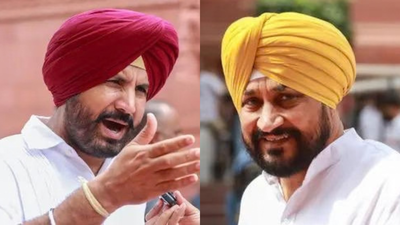
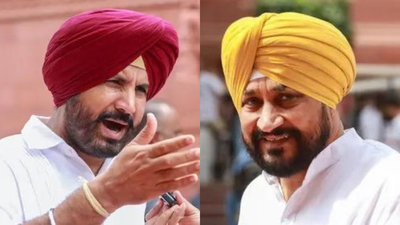
NEW DELHI: The churn in Punjab Congress is now complete. Or is it?Amarinder Singh Raja Warring has quit as the Punjab Congress president after more than four years in the post. The Congress is yet to make a formal announcement, but Warring has already changed his X bio to “Former PPCC President.” Today, he met Rahul Gandhi and handed him his formal resignation.“He (Rahul Gandhi) gave me a lot of love. He sought information about the current political situation in Punjab, on what is happening with the government and what we should be doing there,” Warring said after his meeting.Warring’s departure comes after months of infighting over who should lead the Congress into the 2027 assembly election. This was triggered by Congress’s decision to retain Warring as state unit president in July, ignoring the claims of former chief minister Charanjit Singh Channi. Warring’s exit now marks a victory for Channi and his supporters.
Warring is out, but not down
Warring may be out of his post, but has dropped strong hints that his fight may be far from over. Hours after formally stepping down, Warring targeted his detractors, signalling he is not leaving the field yet. If Warring’s remarks against party incharge Sachin Pilot are any indication to go by, we could well see a reversal of roles in Punjab Congress infighting.In an interaction with news agency ANI, Warring said. “I feel that Sachin Pilot must have decided it was time to remove ‘Raja’ from the post.” Warring, though, added that he had “no concrete proof” of this.
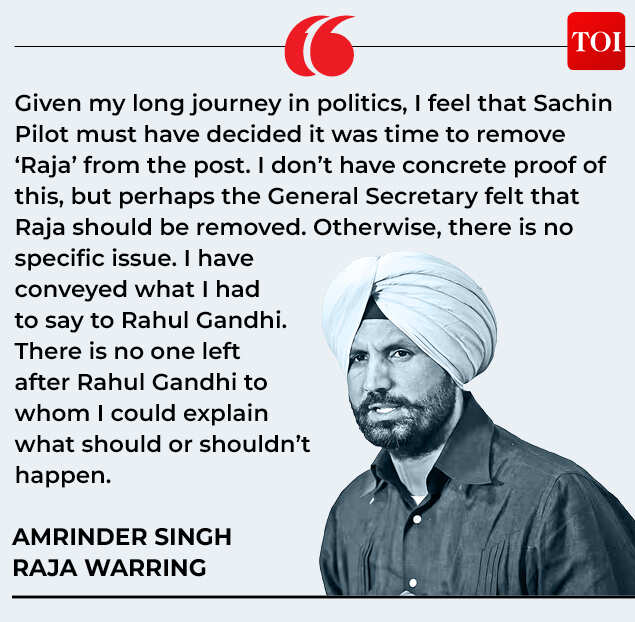
Amarinder Singh Raja Warring hints that Sachin Pilot may have played a role in his exit.
Warring added he had not spoken to Pilot about his exit, but had heard that the state Congress incharge may have recommended a change. “Perhaps the in-charge mentioned that Raja Warring would have to be replaced,” he said when asked about the reasons for his resignation.Taking digs at those responsible for his exit, Warring said nobody had formally asked him to resign. Instead, he had simply read the “direction of the wind”.“Just like elder women who could tell by reading the direction of the wind whether it was going to rain… I observed the situation closely, and it never reached the point where someone had to ask me to resign,” Warring told IANS.That, he said, was why he changed his X bio to “Former PPCC President” even before formally submitting his resignation to Rahul Gandhi.
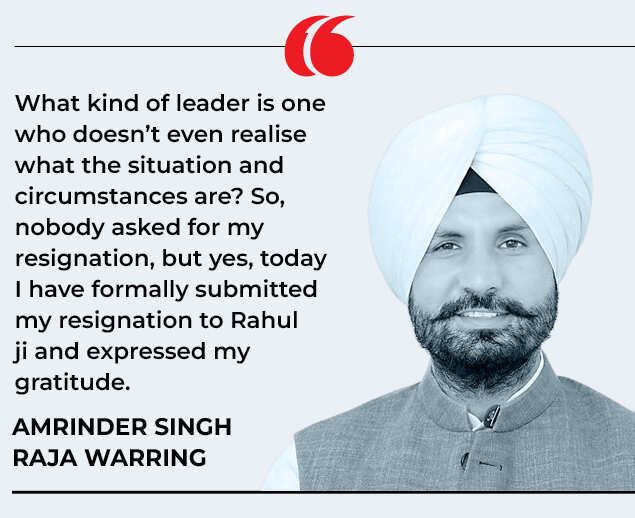
Amarinder Singh Raja Warring said he stepped down as Punjab Congress chief after reading the ‘direction of the wind’
The timing and the turn of events are hard to miss. Nearly a month ago, Congress removed former Chhattisgarh chief minister Bhupesh Baghel as Punjab in-charge after the Channi faction openly rebelled against him. Baghel was accused of favouring Warring and was eventually replaced by Sachin Pilot.But now, Warring appears ready to open a front against Pilot and, of course, also Channi.That also raises questions about whether replacing Baghel with Pilot has actually helped Congress settle the Punjab crisis. Sugata Srinivasaraju, senior political analyst and author, believes that the leadership change appears to have created more confusion rather than resolving the crisis at hand.“What is it that the Congress saw in Pilot that they did not see in Baghel? If you thought Baghel was part of the problem, now Pilot has also become part of the problem. He’s not part of the solution,” he said.According to him, Congress may now have ended up with an even bigger problem. “All of them were against Warring. Now Warring goes out and if Channi is not catered to, then you don’t know what’s going to happen.”That is precisely the dilemma before the high command. Warring’s exit has removed one point of conflict, but unless Channi gets the role his camp has been demanding, the rebellion may simply change sides.Both Baghel and Warring are now out of their roles in Punjab Congress. For the Channi camp, it means one of their biggest demands has been met. But will that end weeks of internal feud and bickering in Punjab Congress? Perhaps not.To understand why Warring’s exit may not be the end of the crisis, it helps to go back to where the tussle began.
How the Channi-Warring tussle began
The crisis began on July 1, when the Congress leadership announced that Warring would continue as Punjab Congress president and Channi would head the campaign committee. Senior leaders Sukhjinder Singh Randhawa and Vijay Inder Singla were also given specific roles for the 2027 assembly election.On paper, it looked like an attempt to balance competing camps. In practice, it did the opposite.Channi’s supporters questioned why Warring was being retained as state chief and began pushing for a larger role for the former chief minister. What was meant to settle the leadership question instead reopened old faultlines within the party.Warring had been appointed Punjab Congress president after the party’s crushing defeat to AAP in the 2022 assembly election. Channi had been the party’s chief ministerial face in that campaign but lost both seats he contested.Warring was then brought in by the Congress high command (read Rahul Gandhi) to rebuild the organisation and prepare it for the next election. For nearly four years, however, the Congress did not clearly announce who would lead its 2027 campaign.When it finally tried to do that in July, the compromise pleased no one.Bhupesh Baghel, who was then Punjab in-charge, tried to defuse the tussle between the Channi and Warring camps but was also caught in the crossfire and forced out of the state.His replacement, Sachin Pilot, initially managed to bring the rival factions onto the same stage during the Congress protest over the Gulzar Singh suicide case. But that show of unity did not last long.What followed was another round of meetings, complaints and feedback to the high command and, eventually, Warring’s exit.
Warring is out. Who gets the chair now?
One of the frontrunners for Warring’s job is former PWD minister and MP Vijay Inder Singla, who was appointed chairperson of the Congress Election Management and Coordination Committee in the July reshuffle.“I am a loyal soldier of the party, and at all times, as a worker of the party, whatever responsibility I have been given, I have always fulfilled my duties. And in the coming times as well, we will work together with everyone in the same manner,” Singla said while reacting to speculation that he could replace Warring.But Singla is not the only name in the mix.Former Olympian and Jalandhar Cantt MLA Pargat Singh, former MLA Rana KP Singh, Raja Sansi MLA Sukhbinder Singh Sarkaria, former chief minister Charanjit Singh Channi and Gurdaspur MP Sukhjinder Singh Randhawa are also among the names being discussed.And this is where Warring’s exit becomes more interesting.The Channi camp has openly demanded that the former CM should lead the party into the next elections. In fact, their demand all along was that Warring should be replaced by Channi. But that has not happened yet.If Channi does get the post, the rebel camp can claim a clear victory. However, if Congress chooses someone else, a compromise candidate, we could see a rerun of what happened in the run up to the 2022 elections.And that would bring Punjab Congress back to a very familiar problem of bitter power tussle between state leaders. A problem that played a key role in the party’s defeat in 2022.Ahead of the 2022 assembly election, then chief minister Captain Amarinder Singh and Navjot Singh Sidhu were locked in a bitter leadership battle. Sidhu wanted a bigger role in leading the party into the election, while Amarinder resisted attempts to cut into his authority.The Congress leadership allowed the dispute to drag on until the crisis became impossible to contain. Eventually, Amarinder Singh was removed as chief minister. Charanjit Singh Channi emerged as the compromise candidate of Congress high command and was made the chief minister.But the compromise did not end the factional war. Congress went into the election divided and suffered a historic defeat, with AAP sweeping into power.Four years later, the names have changed, but the problem looks strikingly similar.Srinivasaraju sees a larger pattern in Punjab Congress’s repeated leadership tussles.“Punjab Congress has not been able to resolve it at all. They’ve had five long years after Amarinder Singh’s exit and they have still not got it right,” he said.His argument is that every time Congress begins to see a chance of returning to power in Punjab, competing factions become more active and start weakening the organisation from within.“We have seen that with Navjot Singh Sidhu and Amarinder Singh,” he said, adding that similar mistakes “seem to be getting repeated”.This time, Channi has played the role of rebel. His rival, Warring, who was brought in after the 2022 defeat to rebuild the party, is now out. But the battle for Channi is still half won. And with Warring all set for a rebel role, the road ahead for the former Punjab chief minister may not be easy.
Share your thoughts in the comments
Be respectful · TOI community guidelines
What would keep Channi and his supporters anxious is the question: will Warring’s loss become Channi’s gain? Or will the Congress once again settle for a compromise candidate, hoping to finish one leadership fight without starting another?