











After police pick up a person, they have exactly 24 hours to produce them before a magistrate. SC has made it clear the deadline starts at the point of detention — not when the arrest is recorded — and exceeding it amounts to a violation of fundamental rights. Sunil Baghel explains.Supreme Court‘s order on detention without prompt production before a magistrate speaks to one of the most fundamental rights – the right to freedom of movement. This is significant because this deadline has often been violated by delay in recording an arrest.The top court has clarified that only the time needed to travel from the place of arrest to the magistrate’s court to produce a suspect can be excluded from the timeframe. Time spent in questioning, searches, seizures or other legal formalities must count towards the deadline.The court, in fact, also went a step further and clarified that sticking to the 24-hour window does not automatically make detention reasonable.In plain English, a suspect must not be held in custody unnecessarily just because police have 24 hours to produce him before a magistrate. They must justify every hour of curtailment of a suspect’s freedom of movement and magistrates must examine how long a person was held and whether that period was justified.

The Nov 5 order followed appeals by three men accused in a case involving the alleged transportation of over 60kg of contraband drugs in Tripura. A bench of Justices Ujjal Bhuyan and Atul S Chandurkar held that their detention violated Art 22(2) of the Constitution and Sec 58 of the Bharatiya Nagarik Suraksha Sanhita (BNSS), 2023 and set aside Tripura High Court’s order rejecting their bail pleas.Customs officials had taken the men into custody on Sept 29, 2025 and their arrests were formally recorded the next morning. They were produced before a magistrate more than 24 hours after they were first detained (see box).When does 24-hr period begin?Art 22(2) of the Constitution says an arrested person has to be produced before the nearest magistrate within 24 hours. Detention beyond 24 hours requires a magistrate’s authority. SC said the clock starts when a suspect is detained and their freedom is restricted, that is, “when his liberty is effectively curtailed”.There is no constitutional basis, it said, for excluding time spent on investigation, interrogation, or legal formalities from the mandated 24 hours.The court also referred to Sec 58 of BNSS, which reflects the restriction in Sec 57 of the earlier Code of Criminal Procedure (CrPC), requiring detention to last no longer than is reasonable in the circumstances, even within the 24-hour limit.What SC said
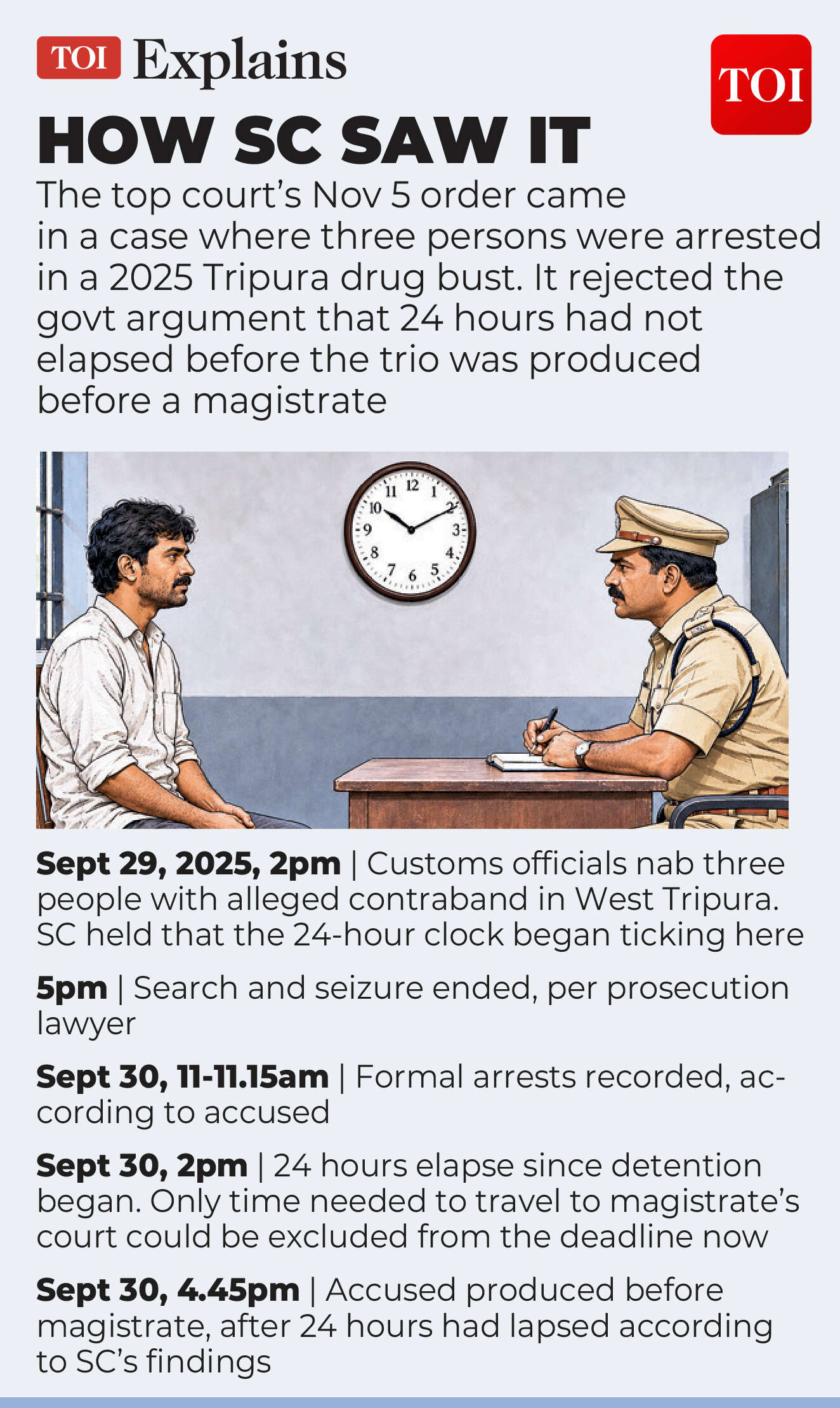
Additional solicitor general Raghavendra P Shankar, representing the Union govt, said the intervening hours before they were produced before a magistrate had been taken up by mandatory procedures like searches, seizures, preparing documents, questioning the accused, etc. He argued that arrest memos could be prepared only after the initial investigation. Until then, they were temporarily restrained to allow the search and seizure process to be completed.The govt relied on Rule 3(4) of NDPS Rules, 2022, which requires seized substances to be classified, weighed, packaged and numbered in the presence of search witnesses and the person from whom they were recovered. The govt argued that the time taken for these necessary steps could not be treated as detention following arrest.The bench examined earlier judgments on what amounts to arrest and custody, including a March 1980 SC judgment that held a person is in custody as soon as he is under the control of an investigating agency or an authority with powers to restrain him. Apart from citing these judgments in support of the accused, SC also rejected three HC decisions relied on by the govt, including Kannan vs State of Tamil Nadu (2026) that held that time spent on mandatory NDPS procedures before formal arrest could be excluded from the 24-hour calculation.SC instead said that search and seizure procedures did not prevent timely production before a magistrate. They could continue after production and authorisation of judicial custody.Why 24-hr safegaurd mattersThe judgment linked prompt production before a magistrate to protection against custodial violence. It cited a Dec 1980 SC judgment – against the backdrop of the Bhagalpur blinding incidents involving prisoners – that said the 24-hour requirement allowed judicial authorities to keep a check on police investigations.The bench also referred to the D K Basu case – that highlighted custodial violence and the practice of questioning suspects without formally recording their arrests, in which SC issued arrest safeguards in mid-90s. The latest judgment recalled earlier judicial concerns about people arrested without warrants being tortured to extract information, recover property or obtain confessions. It also cited an SC ruling in an Enforcement Directorate case, which held that a breach of Art 22(2) makes an arrest invalid and requires the court hearing the bail plea to release the accused.Can bail rules override rights?The court also examined Sec 37 of NDPS Act, which sets strict conditions for bail in cases involving commercial quantities of drugs. Tripura High Court had relied on an April 2026 ruling by a two-judge SC bench that held the two conditions under Sec 37 must be met before bail could be granted in such cases.
Share your thoughts in the comments
Be respectful · TOI community guidelines
The latest Supreme Court ruling questioned the suggestion that the right to a speedy trial under Art 21 must operate within the framework of Sec 37. It relied on the landmark Feb 2021 decision in Union of India vs KA Najeeb, where a three-judge SC bench recognised that strict provisions in special laws could not override fundamental rights under Art 21. It also made clear that NDPS procedures could not weaken the protection against unlawful detention under Art 22(2). In this case, the court found that the unexplained 18-hour gap between the end of search and seizure and the formal arrests was unreasonable under Sec 58 of BNSS, which states that “no police officer shall detain a person arrested without a warrant in custody for longer than is reasonable under the circumstances”.