







NEW DELHI: University Grants Commission (UGC) has issued a fresh public advisory warning students and parents against enrolling in unrecognised institutions, even as its list of fake universities has grown from 20 to 32 in three years. More strikingly, 18 of the 20 institutions flagged in March 2023 continue to figure on the latest list, despite warnings and letters seeking action from state govts.The Nov 17 advisory, issued following Supreme Court directions, has renewed questions over the effectiveness of action against institutions accused of illegally awarding degrees. SC’s intervention followed reports of an alleged fake medical college operating from a farmhouse in Etah, Uttar Pradesh.
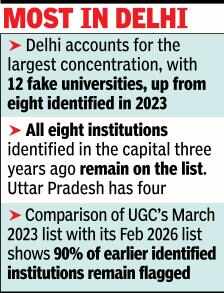
In its Oct 9 order, SC directed UGC and other regulators to issue public advisories cautioning prospective students against unauthorised institutions.A comparison of UGC’s March 2023 list with its Feb 2026 list showed that 90% of the originally identified institutions remain flagged. Continued inclusion, however, does not necessarily mean an institution remains operational or that no enforcement action has been taken.Delhi accounts for the largest concentration, with 12 fake universities, up from eight in 2023. All eight institutions identified in the capital three years ago remain on the list. UP has four, while six other states and UTs have two each. UGC records revealed that the commission wrote to state education authorities in April 2023 seeking action against institutions violating UGC Act, 1956. Follow-up letters were issued in July, while a Sept communication directed the institutions concerned to submit compliance reports within 15 days.
Share your thoughts in the comments
Be respectful · TOI community guidelines
In an Aug 2026 parliamentary reply, the education ministry said states had been asked to register FIRs and initiate steps to close unauthorised institutions. The latest advisory asks students to verify institutional recognition, authority to award degrees, course approvals and permission to operate online, distance or off-campus programmes before paying fees.It cautions against relying solely on advertisements, websites, brochures or social media claims, urging independent verification through official regulatory websites.