







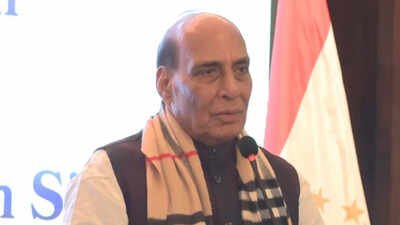
NEW DELHI: Paying rich tributes to Sardar Vallabhbhai Patel on his 151st birth anniversary, defence minister Rajnath Singh on Saturday recalled how the ‘Iron Man of India’ firmly dealt with the Nizam and Razakars, who sought to challenge India’s sovereignty and “laid the foundation of a strong and united India”. On the issue of Kashmir, Rajnath said, “Sardar Patel himself had said that if Pandit Nehru had not intervened, he would have integrated Kashmir as easily as Hyderabad.”Addressing a gathering, the defence minister said, “Sardar Patel was the architect of India’s political and territorial unity, whose extraordinary leadership, courage and unwavering commitment to national interest laid the foundation of a strong and united India”.He further said, “In democracy, govts are formed by winning the trust of the people and on the basis of public opinion, not through violence and anarchy. The path to change of power is elections, not coups. Those who challenge the unity and integrity of India should not forget the history of Sardar Patel.” “Those who dream of weakening India or creating disorder must remember that the land which gave birth to Sardar Patel has also given birth to Narendra Modi,” the minister said.He also criticised Congress and its allies for their use of the term ‘regime change’. He emphasised that ‘regime change’ essentially implies a coup, violence, anarchy and civil war.Rajnath said that Sardar Patel firmly believed that India should never seek what does not belong to it, but should never give up what rightfully belongs to it, under any circumstances. He said that India continues to move forward guided by this very principle. “India does not seek to occupy anyone else’s territory, nor does it initiate conflict. However, it remains resolute in securing what rightfully belongs to it and safeguarding its national interests.”He further asserted that whether it is avenging terrorist attacks or reclaiming Pakistan-occupied Kashmir (POK), India remains firmly committed to defending its rights and sovereignty.Recalling the events surrounding the Congress presidential election of 1946, the minister said that despite overwhelming support from provincial Congress committees, Sardar Patel withdrew his candidature in deference to Mahatma Gandhi’s wishes. “For Sardar Patel, the country was always bigger than the chair. Duty was more important than position, and national interest was greater than personal ambition.”The defence minister expressed concern over what he described as the historical neglect of Sardar Patel’s contributions and recalled that Patel was conferred the Bharat Ratna only in 1991, nearly four decades after his demise. He also referred to the contrast between the celebrations of Jawaharlal Nehru’s birth centenary in 1989 and the relatively subdued observance of Sardar Patel’s birth centenary in 1975. He credited PM Modi with restoring national recognition to Patel’s legacy through the Statue of Unity, Rashtriya Ekta Diwas, Run for Unity and Ekta March. “Sardar Patel was a great leader in his own right. Honouring him has not made him any greater; rather, it has brought greater honour to India.”
Share your thoughts in the comments
Be respectful · TOI community guidelines
Highlighting Sardar Patel’s emphasis on military modernisation and indigenous production of weapons and ammunition, Rajnath said that India’s growing defence manufacturing capabilities reflect the spirit of self-reliance that Patel advocated. He said that Sardar Patel’s legacy extends far beyond the integration of princely states. It is reflected in India’s strong administrative institutions, national security, social harmony and commitment to national interest. He said that the vision of ‘Ek Bharat, Shreshtha Bharat’ and the mission of building a Viksit Bharat are inspired by the ideals that Sardar Patel upheld throughout his life.“India’s greatest strength lies in its unity. We must never allow internal differences to weaken our national resolve. Preserving India’s unity and integrity is the responsibility of every citizen,” he said.