








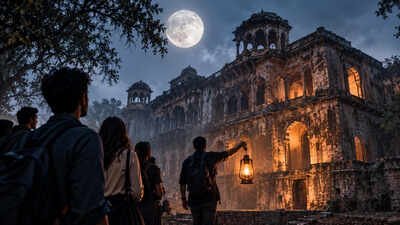
India’s ghosts have a customer service problem.There is almost an abundance of local places which have a reputation of being haunted in each and every state.There are ghost villages where nobody is quite sure why everyone left. Forts with stories of spirits walking through them at night. Abandoned cemeteries as old as the world wars, forgotten ‘havelis’ and stretches of forest that have acquired a mythology of their own.Out of all these only a few have become tourist attractions; others survive largely through word of mouth, local lore and the occasional paranormal investigation.India’s haunted places do have an audience but it somehow lacks a concrete machinery that could make ‘dark’ tourism and ‘spectral’ cities central factions of an ever growing tourist economy.
The business of the macabre
The tourism industry has a name for this particular appetite for the unsettling: dark tourism. The term broadly describes travel to places associated with death, tragedy, violence and suffering.Ghost tours, haunted heritage walks and visits to places associated with paranormal folklore occupy a more specialised corner of this spectrum, where history, local legend and the promise of an eerie experience often intersect.It is an appetite that the tourism industry has increasingly tried to package. Turning a city’s darker history into something you can book online. And its most ideal form, the ticket buys you a completely immersive tour full of storytelling with a slight hope of encountering your first paranormal spirit.
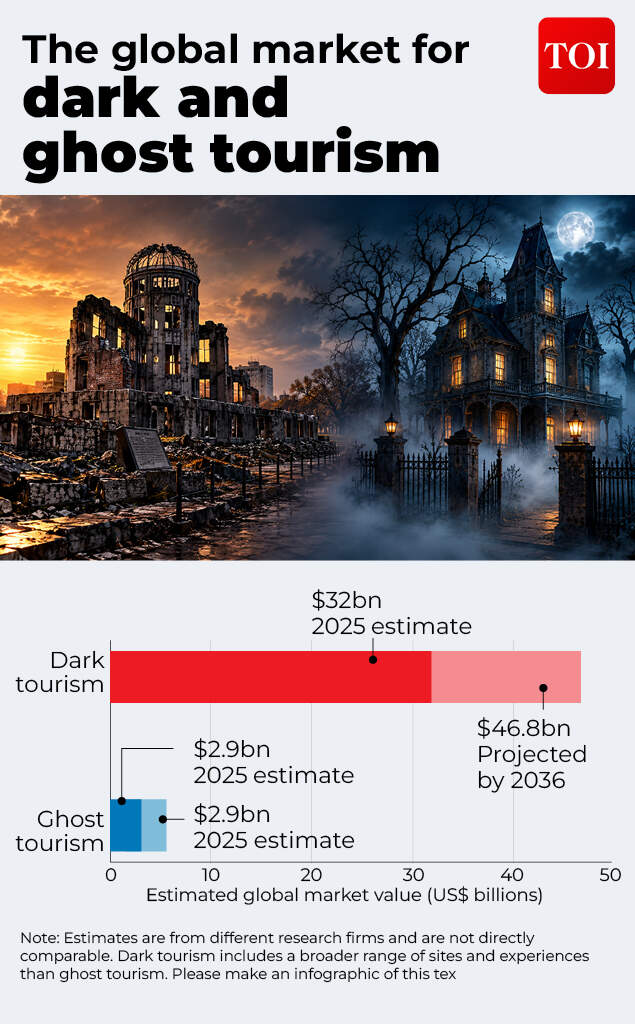
The commercial potential of dark tourism is reflected in the market estimates. Grand View Research valued the global dark tourism market at $31.8 billion in 2023 and projects it to reach $34.2 billion in 2026 and $38.6 billion by 2030, growing at a compound annual growth rate of 2.9%. MR puts the market at $32 billion in 2025, forecasting it to reach $46.8 billion by 2036.The market for ghost tourism as a separate entity is estimated to be worth $2.9 billion in 2025 and projects it to grow to $5.7 billion by 2034, at a CAGR of 7.8%, by Dataintelo. Its estimate includes guided ghost walks, cemetery and underground tours, paranormal investigations, haunted stays and virtual experiences.For India, the more immediate question may be less about capturing a share of a global market and more about whether these scattered attractions can be turned into viable profitable local experiences. With a history as rich as ours, the ghosts are not in short supply. The challenge is to turn them into profitable experiences that people can discover, book and pay for, while ensuring that the tragedy is respected and the communities living alongside these places have a stake in the business.
From a haunted reputation to a tourism product
Kuldhara, a site that Rajasthan Tourism itself promotes as a “ghost village shrouded in mystery”, is a good starting point. The official government site describes its history as a prosperous settlement abandoned in the early 19th century. The account recounts the popular legend involving the village headman’s daughter and the powerful minister Salim Singh, while also identifying the ruins as a protected monument under the state archaeology department.The village, around 17km from Jaisalmer, already has the ingredients of a tourism attraction, but having a story and having a well-managed visitor experience are two different things.There are multiple accounts of litter around the site, including discarded plastic and food packaging. How can an atmosphere feel haunted when the landscape is strewn with chips and tobacco packets?And cleanliness isn’t the only issue. Talking to two people who visited the site, the common experience has been mismanaged and under researched tour which leaves most customers underwhelmed at the end of the day.
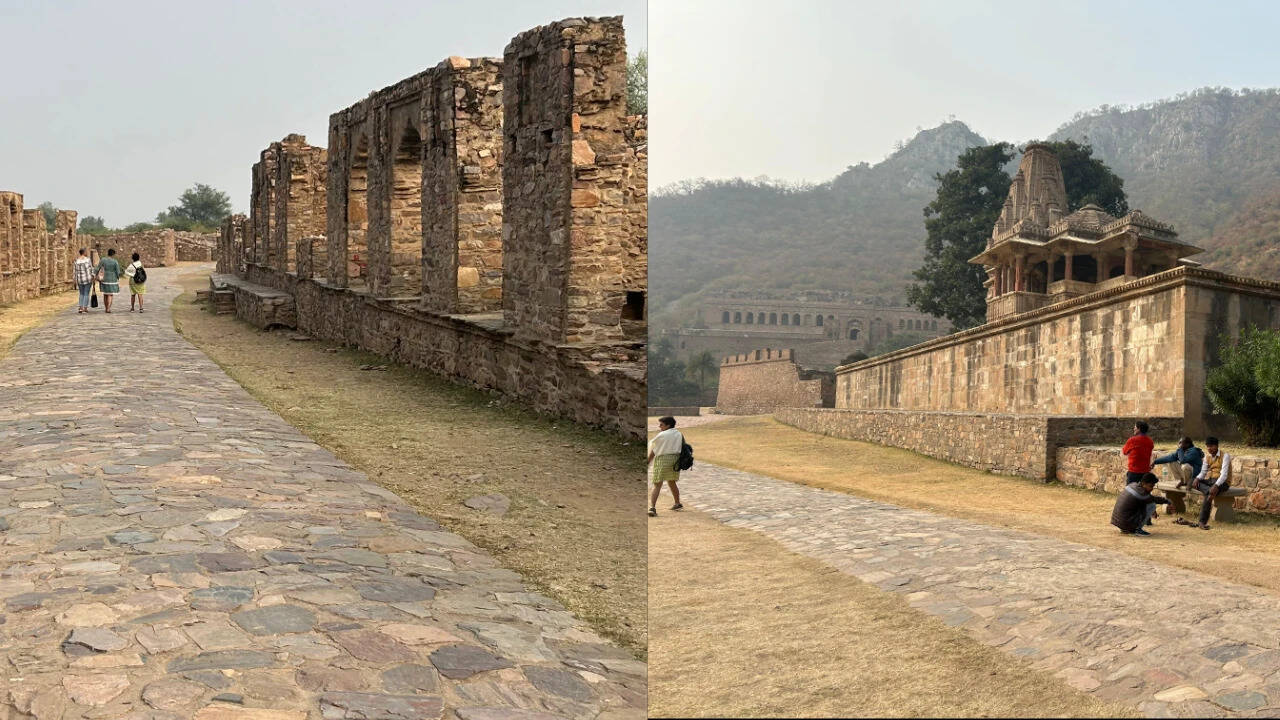
Bhangarh, in Alwar district, is often described as one of India’s most haunted places. Rajasthan Tourism itself recounts the two popular legends attached to the site: one involving the ascetic Baba Balu Nath, whose warning about the shadow of the fort was allegedly ignored, and another about a sorcerer whose failed attempt to enchant Princess Ratnavati supposedly led him to curse the town.The legends have become part of the destination’s appeal, drawing visitors to its ruined temples, palaces and deserted marketplace. The restriction on entry before sunrise and after sunset, imposed at the site, has only added to its mystique. But tourists who visit the site have also called it unorganised, speaking to TOI they noted that the guide also was not entirely accurate about the historical aspects of the site and the site itself needed to have better management.
The business of making a place come alive
There are already attempts to package India’s haunted heritage into guided experiences. Delhi Tourism lists Haunted Heritage Walks at Malcha Mahal and Feroz Shah Kotla Monument, each lasting around 90 minutes and available on weekends on group demand. The official booking page lists a minimum group size of six and a tariff of Rs 800 plus GST per person.The Ministry of Tourism’s Utsav portal has also listed a Haunted Walk at Bhuli Bhatiyari, organised by Delhi-based Enroute Indian History. The listing describes a guided heritage walk through the old hunting lodge, combining its history with the legends associated with the site.Enroute Indian History, which has been conducting the experience for around two to three years, says the walks attract a good number of bookings and are designed for adventure seekers as much as for history enthusiasts. The operator says it takes care to keep the historical information accurate, while folklore and supernatural accounts are presented as stories rather than fact-checked historical claims. This distinction is central to the format: visitors are offered a combination of documented history, local legends and the possibility of an unsettling experience.These initiatives complicate the idea that haunted tourism in India is entirely informal or absent. There are government-backed products and private operators working in the space. The question is whether they have developed the consistency, visibility and scale needed to make haunted experiences a dependable part of a destination’s tourism economy.
Ghost is only part of the experience
Detailing her experience to TOI, Kriti notes that she remembers the underground setting of the haunted heritage walk she took in Edinburgh as much as the stories themselves. The interactive displays and historical details provided by the guide gave the experience a sense of depth that a conventional ghost walk might not have offered.A ghost tour can take several forms, the attraction lies as much in how visitors encounter the story as in the story itself.A 2020 study published in Cornell Hospitality Quarterly, titled Paranormal Tourism: Market Study of a Novel and Interactive Approach to Space Activation and Monetization, makes this case through examples from the United States and elsewhere. It describes how destinations such as New Orleans combine ghost stories with local histories and cultural associations, while Salem packages its reputation around witches and ghosts. These places do not necessarily sell a standalone encounter with the paranormal; they draw on identities and histories that visitors may already associate with them.The study talks in detail about Eastern State Penitentiary in Philadelphia, a former prison that closed in 1971 and subsequently fell into disuse. Limited group tours began in 1988 as part of efforts to preserve the site. A Halloween fundraiser followed in 1991, eventually developing into the annual attraction Terror Behind the Walls. By 1994, the former prison was also offering daily historical tours to generate income for preservation, followed by museum exhibits and a broader marketing campaign.The study also points to the role of participation in making these experiences engaging. The experience can continue beyond the visit itself, with reviews, photographs and word of mouth helping to draw in new audiences.
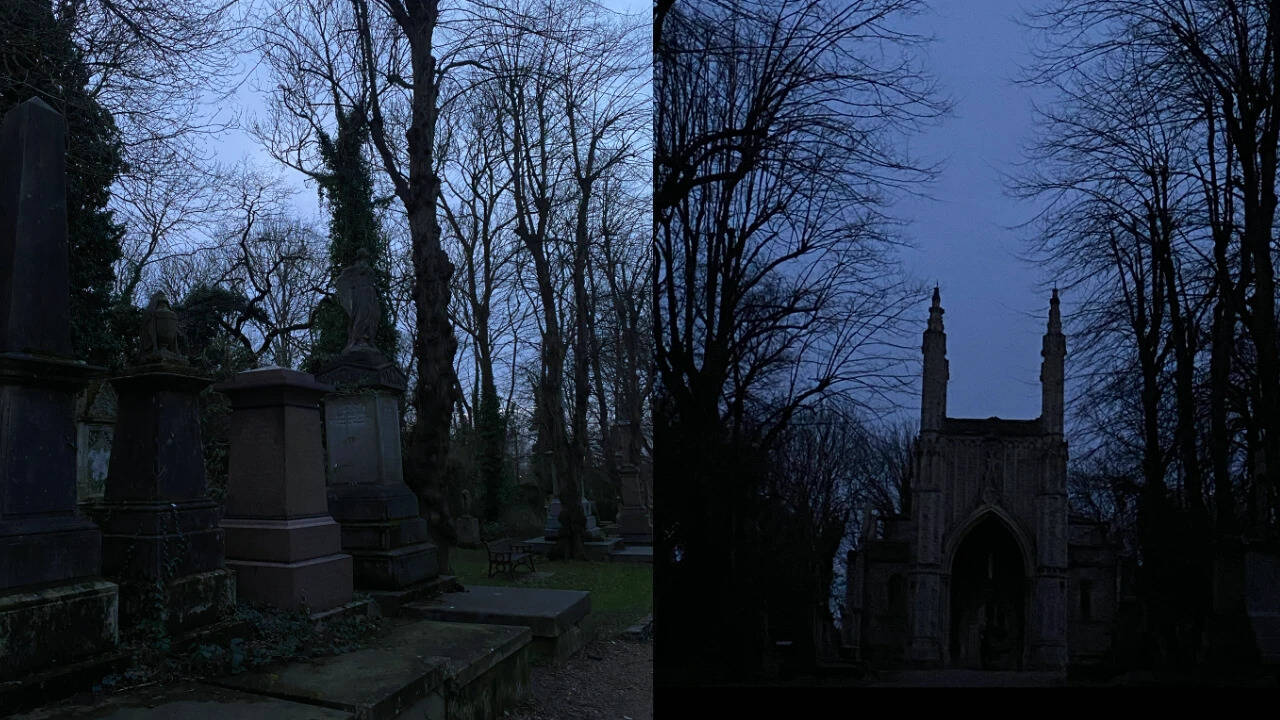
Research into British ghost walks suggests that the appeal is not necessarily dependent on visitors believing in ghosts. An ethnographic study of 14 tours across Edinburgh, York, London and Brighton found that guides use a combination of storytelling, performance and the physical environment to make history tangible.For India, that distinction could be important. A haunted experience need not rely on sensational claims. It can be built around the history of a place, the folklore that has accumulated around it and the atmosphere of encountering that story on location.
Local community cannot remain part of the backdrop
The opportunity, however, is not simply to make India’s haunted sites more theatrical or commercially attractive. It is also to ensure that the people and places behind the stories are not left out of the value chain.A 2023 qualitative study of local perceptions in Kuldhara, based on 25 interviews with residents and people working in the area, found that respondents saw several economic opportunities in developing mystery and paranormal tourism. Some respondents also pointed to existing livelihood opportunities linked to visitors, including guiding, transport and the sale of local crafts.The study also recorded expectations around the restoration and preservation of the village, alongside concerns about the role of government and private bodies in developing the destination. While it offers a glimpse of how residents view the possibilities of mystery tourism, it does not quantify how much income currently reaches the community or how widely those benefits are distributed.The concerns are not unique to haunted destinations. A 2026 study of tourism in Uttarakhand, while not focused specifically on ghost tourism, raises wider questions about the state’s tourism economy. It argues for stronger community participation, local supply chains, training and livelihood diversification.These concerns are relevant when considering how niche tourism experiences might develop in the hills. A haunted walk could create work for local storytellers, drivers, homestays, food vendors and artisans. But those benefits are not automatic. If an outside operator controls the bookings, supplies the guides and takes most of the revenue, the local community may remain little more than a feature of the landscape.The challenge is to move beyond treating local legends as raw material that can be packaged elsewhere. Residents may be the custodians of oral histories, but they should also have a stake in how those histories are interpreted and monetised.
Share your thoughts in the comments
Be respectful · TOI community guidelines
India does not need to manufacture a haunted history. What it needs is a way to bring those stories to visitors without reducing them to cheap thrills or leaving the people who have preserved them out of the business.The real test of India’s haunted tourism economy will not be how many people it can convince that a place is haunted, but how many people it can persuade to stay, listen, and explore.The ghosts, after all, have been doing their bit for the tourism industry for years. It is time someone took care of the guests.